


Grafting compounding stands as a pivotal method within polymer engineering, allowing the directed chemical alteration of macromolecular structures to simultaneously augment material behavior and broaden the functional repertoire of polymers. Through the covalent addition of specific functional entities along the polymer backbone, grafting significantly elevates interphase compatibility, interfacial adhesion, and chemical endurance, making the approach a key enabling technology for sophisticated systems such as fiber-reinforced composites and multilayer barrier films. The advent of reactive extrusion—most successfully implemented within co-rotating twin-screw extruders—has conferred a decisive advantage by integrating on-the-fly polymer functionalization, feeding, mixing, and devolatilization into a continuous operation of minimal residence time. The present article articulates the mechanistic underpinnings of grafting compounding, elucidates the performance capabilities of modern twin-screw devices, and surveys the frontier applications of grafted composites in contemporary materials engineering.
Understanding Grafting Compounding
Definition and Significance of Grafting
Grafting compounding refers to the covalent attachment of pre-designed functional moieties onto the main chain or pendant sites of a base polymer to augment the material’s physicochemical performance. By introducing pendant sites of tailored reactivity, grafting routinely improves interphase phenomena, compatibility with fillers, and localized mechanical strength. Such modifications render the polymer responsive to environments that go beyond the application of the base material.
The utility of grafting compounding is underscored by polymer systems that require specialized functionalities—for instance, a graft allows a polymer to selectively bind to a reinforcing fiber, improving mechanical transfer, or introduces polar functions that generate tenacious interfaces within coextruded opacity systems. The broad scope of applications, spanning automotive coatings to biomedical scaffolds, validates grafting as essential in polymer design.

The Grafting Compounding Procedure
Grafting compounding is frequently performed in a twin-screw extruder to ensure thorough dispersal and to minimize residence time. Key operational stages include:
- Feeding: The carrier polymer, grafting co-monomer, and peroxide or redox system operating as the radical generator are introduced in a single-feed, gravimetrically metered manner, avoiding pre-mixing that could prematurely activate the radical source.
- Thermal and Shear Activation: Zones of the extruder are selectively heated to a temperature that guarantees the de-composition of the radicals immediately upon formation, while intermeshing screws provide uniform transport and adequate shear to maximize the interfacial contact of grafting constituent and backbone.
- Covalent Stabilization: The resulting radicals on the polymer screen undergo rapid propagation with the grafting modifier, yielding a grafted macromolecule in which the grafted chain is permanently anchored, thereby merging the functional modification with the polymer’s original crystalline or amorphous topology.
- Vent and Cool Stage: Water and low-boiling volatiles are eliminated through strategically positioned venting ports, after which the grafted polymer is rapidly cooled and formed to its target geometry.
This sequential approach guarantees reproducible grafting and homogeneous material properties, which are essential advantages for scaled-up production runs.
Applications of Grafted Polymers
Due to their tailored characteristics, grafted polymers find numerous applications across multiple industry sectors. Selected representative uses include the following:
- Compatibilizers: Grafted structures decrease interfacial tension between otherwise immiscible polymers, thereby facilitating the manufacture of high-performance thermoplastic and thermoset composites.
- Adhesion Promoters: Grafted intermediates function as tie layers in multilayer film architectures, reliably enhancing adhesion strength in barrier, optical, and food-contact applications.
- Barrier Materials: Grafted polymers bearing reactive functional groups, including hydrophobic cyclodextrins and oxygen scavengers, endow packaging films with substantially elevated barrier performance and shelf-life extension.
- Recycling: Targeted grafting improves the processability and end-use properties of recycled feedstocks, effectively elevating their utility to construction, consumer, and automotive-grade applications.
The breadth of these functionalities firmly establishes grafting as a cornerstone technology for advanced material creation across multiple end-use environments.
The Role of the Extruder in Grafting Processes
Types of Extruders Convenient to Grafting Operations
Extruders assume a pillar-level function in grafting workflows, with the single- and twin-screw configurations emerging as the prevailing classifiers. The morphological distinctions of each type dictate the procedural merits available for grafting tasks of varying intricacy.
- Single-Screw Extruders: Economically advantageous and mechanically streamlined, these machines serve scenarios requiring basic grafting totally devolving on modest mixing and directional shear stresses. Their functional simplicity and favorable capital enclosure render them credible for elementary grafting assignments.
- Twin-Screw Extruders: For grafting protocol encumbered by high complexity, the twin-screw version provides a strategic competitive advantage. The parallel, intermeshed architecture of the screws confers high-turbulence mixing, fine thermal and viscometric control, and adaptability to high-melting-point polymer matrices. The resultant specification of twin-screw devices consolidates capacity for extensible, high-volume grafting production and net productivity.
Extruder selection must respond holistically to the polymer-rheological properties, targeted extent of grafting, and desired quantum of throughput.
How Extruders Enable Controlled Chemical Reactivity
Extruders function impersonally as inline reactors conditioned for gradation of grafting polymer chemistry. The conditioning paradigm is summarised as ensuring:
- Gradation of Thermal Stability: Sequential zonal temperature controls arrayed in the barrel generate precisely congruent thermal profiles for activation of both polymer backbone and grafting chemical.
- Induced Shear, Coupled with Dispersive Shear: The helicoidal motion of the screws engenders quantised shear deformation, ensuring optimal dispersion of polymer backbone, grafting reagents, and, where warranted, initiators. The resultant isothermal, continuously mixedzone ensures step kinetics coherently translates to polymer architecture modulation.
- Residence Time: The interaction of screw speed and barrel length controls the dwell time of the feed stream, permitting the grafting reaction to progress to completion under the prescribed kinetic and thermodynamic regimes.
- Venting: Strategic placement of venting channels evacuates volatile by-products—chiefly moisture and non-condensed monomers—thereby mitigating potential nucleation sites and preserving the mechanical integrity of the resultant polymer.
The effective synergy of elevated temperature, mechanical shear, and equilibrated thermal profiles renders the extruder a paramount apparatus for grafted polymer compounding.
Design Considerations for Extruders in Reactive Extrusion
The engineering of an extruder for reactive compounding demands a multifaceted approach in the following arenas to attain process efficiency and product fidelity:
- Screw Configuration: The introduction of customized screw geometries, including kneading blocks and helical reversion zones, augments interfacial shear while modulating stagnation zones to promote homogenous grafting.
- Barrel Length: An elongated barrel length augments mean residence time, thereby favoring reaction equilibria for multi-component grafting systems. This advantage must, nonetheless, be counterbalanced against thermal accumulation that may promote substrate degradation.
- Venting Zones: Discrete venting compartments, configured at periodic axial intervals, expedite the continuous extraction of gaseous and low-boiling side-products, thereby enhancing the thermal and compositional homogeneity of the melt.
- Material Compatibility: The selection of screw and barrel materials must accommodate elevated process temperatures and the reactive oligomers generated, thus ensuring prolonged operational fidelity and material integrity.
By incorporating these foundational design principles, process engineers can elevate the throughput and purity of extruded grafted polymers, ensuring that the resultant materials possess the defined functional characteristics required by target applications.
Polymer Grafting Techniques
Overview of Grafting Techniques
Polymer grafting is a strategic modification approach in materials science, involving the covalent attachment of side chains or functional groups to a polymer backbone to tailor specific properties. Through this framework, grafted polymers achieve performance levels required by targeted applications. Manifestly, the leading grafting modalities include:
- Free Radical Grafting: By leveraging free radicals—commonly induced through peroxides—the grafting platform degrades the polymer backbone, thus enabling subsequent covalent bonding with grafting monomers. This versatility, coupled with operational straightforwardness, secures the technique’s predominance in both academic and industrial landscapes.
- Grafting via Reactive Extrusion: Grafting is carried out in a continuous, high-viscosity reactor. The superposed influence of melt, shear, and in-situ monomer supply renders the reactor a micro-batch polymer grafting zone. The dimension of this approach is scalability, notably advantageous for industrial mass production.
- Plasma-Induced Grafting: Radio frequency or atmospheric-quality plasma jets functionalize the polymer surface by generating oxygen, nitrogen, or carbon-based radicals. Post-secondary monomer infusion permits the spontaneous grafting of ionic, hydrophilic, or hydrophobic groups. The meritorious yield lies in the preservation of bulk mechanical and thermal properties, limiting the grafting to polymer exterior.
You will find the choice between the aforementioned strategies intricately linked to the target polymer properties and the specific end-use requirement.
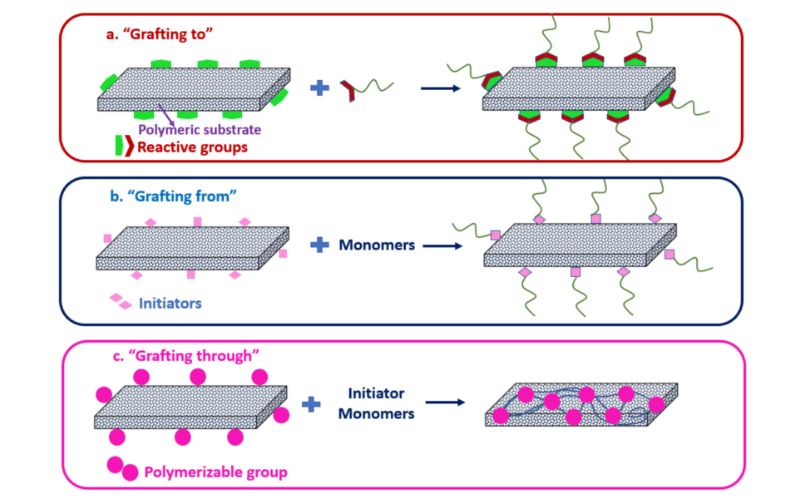
Surface Modification through Grafting
Surface modification by grafting allows for selective tailoring of polymer surface chemistry while maintaining the mechanical integrity, thermal history, and bulk microstructure of the core material. Grafted layers, typically in the nanometer to micrometer range, confer or refine key functionalities: enhanced adhesion for multilayer films, precisely engineered wettability via grafted hydrophilic chains, or augmented chemical stability through the covalent anchoring of protective polymer domains. This capability renders surface grafting an indispensable technique across a broad range of applications from biomedical implants to microelectronic packaging.
- Hydrophilic Surfaces: Covalent grafting of hydrophilic moieties onto polymer surfaces substantially elevates aqueous compatibility, rendering substrates suitable for elongated exposure in medical devices, filtration membranes, and similar environments.
- Anti-Fouling Coatings: Surface-initiated polymer brushes exhibiting broad-spectrum anti-fouling characteristics kinetically inhibit marine biofilm formation, sustaining prolonged hydrodynamic performance in marine and offshore infrastructure.
- Adhesion Enhancement: Di- and multi-functional grafted polymers serve as interfacial modifiers for coatings, paints, and formulated adhesives, facilitating superior tensile and cohesive strength under thermal, wet, and chemical stress.
Collectively, these surface modifications broaden commercial polymer portfolios, coupling functional durability with application latitude across biotechnology, marine, and protective-coating sectors.
Enhancing Compatibility in Polymer Blends
Grafting achieves thermodynamic compatibilisation of otherwise immiscible polymer blends, enabling the rational design of multi-functional, high-performance materials. By appending specific functional groups proven to exhibit favourable enthalpic interactions with both immiscible phases, grafting shrinks interfacial tension, curtails macroscopic phase domains, and refines tensile, impact, and thermal properties.
- Compatibilizers: Maleic anhydride-grafted polyolefins, when properly tailored, serve as efficient interface modifiers, yielding substantial gains in tensile modulus, thermal stability, and impact strength across polyolefin/engineering thermoplastic blends.
- Barrier Properties: In multilayer polyolefin sheeting, grafted polyamide or polycarbonate layers reinforce interparticle adhesion, markedly augmenting water vapour, oxygen, and aroma barrier, essential for food, pharmaceutical and biomedical packaging.
- Recycled Materials: Grafted polyphenylene oxide or polystyrene segments neutralise melt-flow deficits, thermal degradation, and insoluble gel formation in post-consumer and post-industrial feedstocks, enabling reliable re-integration with virgin resins and thus promoting circular economy.
Recent developments in grafting methodologies enable polymer blends to conform to the exacting standards demanded by contemporary sectors, spanning automotive manufacturing, advanced packaging, and a wide array of other applications.
Reactive Extrusion and Its Benefits
Mechanisms of Reactive Extrusion
Reactive extrusion integrates simultaneous chemical reaction and polymer shaping within a continuous screw-driven system. The extruder is initially charged with formulated feeds comprising monomers, polymer carriers, curing agents, and any desired fillers. Inside the screw barrel, localized shear, temperature, and pressure gradients activate polymerization, crosslinking, or co-reaction mechanisms.
The screw configuration is tailored to enhance dispersive and distributive mixing, ensuring a uniform thermal profile along the extruder length. Programmable temperature zones and a selectable flight pitch provide explicit control over thermal gradients and effective residence time, thus establishing narrow thermal and chemical variability around each particle. Condensable by-products, such as water or light solvents, are continuously swept out by a degassing port, upgrading the final composite’s purity and crosslink density.
Advantages of Using Reactive Extrusion for Composites
The technique presents a series of strategic advantages for advanced polymer composite manufacturing, consolidating process efficiency, material performance, and environmental sustainability.
- Processing Efficiency: By amalgamating polymer synthesis, curing and shaping into a single continuous cycle, reactive extrusion curtails thermal and mechanical histories, minimizing both capital equipment and scheduling delays typically required in batch or downstream curing methods.
- Material Improvement: In-situ mechanochemical functionalization, through grafting, graft copolymerization or selective crosslinking, yields composites that exhibit markedly superior tensile strength, impressive thermal deflection temperature and a pronounced reduction in filler-surface incompatibility. These features result in performance gradients not attainable through post-additive blending, thus extending the applicability of polymers into high-performance and thermal environments.
- Customizable Formulations: Reactive extrusion permits tight compositional and structural control of composite systems, empowering formulators to engineer materials that meet defined performance criteria, such as those demanded by structural components in automotive and barrier films in packaging applications.
- Scalability: The intrinsically continuous mode of reactive extrusion yields processes that transition seamlessly from laborator-scale validation to plant-scale manufacture, conferring a high degree of logistic flexibility in responding to progressive market volumes.
These attributes collectively render reactive extrusion a compelling, economically advantageous route for fabricating high-value composite systems.
Challenges in Reactive Extrusion Processes
Notwithstanding its compelling merits, reactive extrusion embodies technical obstacles that merit systematic redress to achieve reliable deployment:
- Incomplete Reactions: Full reactant conversion often proves elusive in high-viscosity melts, where shear and diffusive mixing deficiencies promote residual monomers, adversely affecting purity and property uniformity.
- Thermal Degradation: Process-generated thermal gradients, if uncontrolled, can exceed thermal stability thresholds of the polymer host, perpetrating chain scission, color stability decline, tensile modulus erosion, and problematic side reactions.
- Process Control: Continental stability of control parameters—including plate melt zone thermal profile, barrel-pressure, and differential residence-time distribution—poses a relentless challenge within the high shear, homogeneous curing zone characteristic of extrusion dies.
- By-Product Management: The singular imperative to evacuate reactive volatiles such as evolving water or alcohol, in concert with an appropriately calibrated devolatiling vent, remains an obligatory safeguard; failure results in inducted inclusions, transparency defects, and mechanical property scatter.
Mitigating these obstacles necessitates meticulous tuning of extrusion parameters, the incorporation of state-of-the-art equipment architecture, and the deployment of integrated, real-time monitoring capabilities to uphold uniform quality and production excellence.
Applications of Grafted Composite Materials
Thermoplastic Grafted Composites
Thermoplastic grafted composites are increasingly employed in sectors that require a unique combination of low density, high durability, and superior mechanical performance. By covalently attaching reactive side groups to thermoplastic polymers, the materials exhibit enhanced low-polarity compatibility with potential reinforcements, such as glass or carbon-fiber filaments.
- Automotive Industry: These composites are selectively incorporated in exterior components, cabin trims, and safety-critical braces to attain superior impact energy absorption while simultaneously lowering the car body mass, contributing meaningfully to the mpg rating.
- Aerospace Applications: The low coefficient of thermal expansion and high tensile modulus acquired via grafting make the composites indispensable in cabin furnishings and semi-structural spars, where the compromise of mass and mechanical integrity cannot be tolerated.
- Consumer Goods: Sports racquets, durable carrying cases, and shock-protected housings display longer service lives, lower weight, and aesthetic versatility, thus directly benefiting from grafted thermoplastic composites.
These exemplar fields collectively reaffirm the capability of thermoplastic grafted composites to satisfy contemporary design and performance exigencies.
Use of Modified Cellulose in Composites
Cellulose, when chemically modified by grafting carboxyl or hydroxyl groups, has emerged as a sustainable and mechanically competent filler in composite formulations. The polymer’s intrinsic high aspect ratio, low carbon-footprint absorption, and biodegradability present a responsible alternative to traditional mineral and glass fibers.
- Packaging Materials: When incorporated into poly-lactic-acid matrices, the grafted cellulose not only reinforces tensile strength but simultaneously elevates gas and moisture barrier performance, thereby prolonging shelf life in agricultural films and thermoplastic trays while curbing the incorporation of persistent petroleum films.
- Construction: Cellulose-armored composites are integrated within wall panels, insulation sheets, and similar structural components, providing architects and builders with a low-impact option that simultaneously fortifies mechanical integrity and thermal efficiency.
- Medical Applications: Surgically implanted fibres are chemically modified to reinforce resorbable scaffolds and semi-permeable dressings, ensuring compatibility with human tissue and a rate of enzymatic breakdown that harmonises with tissue healing.
Through these embodiments, engineered cellulose not only elevates the mechanical and thermal profiles of composite systems but also catalyzes the transition to low-energy, low-emission production routes.
Future Directions in Composite Material Evolution
Aggregate composite science is surging forward, fuelled by refinements in surface-grafting methods and by sectors demanding low-carbon solutions. Fundamental trajectories are as follows:
- Smart Composites: Molecular signal grafting generates components that mechanically reorganise themselves in the thermal, electromotive, or micro-hydro fields, culminating in self-repairing dressings and robotic exoskeletons capable of pessimal, task-driven postures.
- Recyclable Composites: Dual-pattern functionalisation allows module-level mechanical fastening to be unfastened with temperature or solvent, simplifying the physical short-circuiting and chemical graduation of components to theme-level crystals of cellulose and residual resin.
- Nanocomposites: Lattice-coupled grafting confines three-dimensional, interface-coated graphite to nanoscaled regime; concurrent enhancement of the matrix magnitude generates composites that exhibit moduli five times greater, simultaneous electrical mobility in excess of 10S/m, and thermal conductivity above 25W/mK.
- Bio-Based Composites: Matrix bioplastics woven with chemically engineered fibres exhibit structural, thermal, and dielectric properties, while enabling cradle-to-cradle degeneration with a lifecycle-driven carbon credit approximately 45% above petrochemical equivalents.
Progressing toward the future of composite materials, prevailing vector forces are simultaneously elevating performance specifications, reinforcing sustainability imperatives, and catalyzing continuous innovation across various industrial sectors.
Frequently Asked Questions
What is the grafting process in polymer science?
In polymer science, grafting is the procedure whereby a polymer main chain is chemically modified by appending side chains or branches composed of otherwise distinct monomers. By controlling the length, composition, and arrangement of the grafted segments, one can fine-tune the material’s thermal stability, mechanical performance, and interfacial adhesion. The grafting can be achieved through a variety of synthetic strategies, including graft polymerization that proceeds from the backbone and strategies that anchor chains to polymer surfaces. The end products, termed graft copolymers, display remarkable adaptability and can be engineered to mate well with a wide array of processing matrices.
How does grafting compounding enhance the properties of plastic compounds?
Grafting compounding augments the performance of plastic compounds by grafting carefully selected monomers directly onto precursor polymer chains during melt processing. The resulting chemical decoration modifies properties including tensile strength, thermal resistance, and surface energy, while simultaneously enhancing interfacial compatibility with fillers, reinforcements, or other polymers. This is typically accomplished by introducing thermal or photoinitiators and tailored reactive additives concomitantly in the compounding extruder. The process facilitates the derivation of multipurpose masterbatches in a one-step operation and enables custom fine-tuning of the material’s response to processing and end-use conditions.
What is the role of an initiator in the grafting reaction?
The initiator is pivotal in the grafting reaction by producing free radicals or reactive species that commence the polymerization of the introduced monomers. Techniques such as atom transfer radical polymerization benefit from the initiator, as it governs the covalent attachment of monomers to existing polymer chains. By varying the concentration of the grafting initiator, researchers can achieve precise control over the grafting density and, consequently, the physicochemical characteristics of the obtained graft copolymer.
What are the advantages of using polyethylene in grafting processes?
Polyethylene is frequently chosen as the substrate in grafting methods on account of its excellent mechanical strength, inherent chemical resistance, and straightforward polymeric architecture that readily accommodates modification. Grafting not only imparts copolymers with enhanced thermal stability but also ensures improved compatibility with a broad spectrum of functional additives and fillers. Furthermore, tailored modification of its surface properties permits significant gains in adhesion, rendering grafted polyethylene particularly effective in protective coatings and composite reinforcement.
To what extent do grafting techniques modify material surface properties?
Grafting techniques substantially modify material surface properties by attaching functional moieties or polymer chains directly to the substrate interface. This loading alters surface free energy, expands chemical compatibility with adjacent phases, and reinforces adhesive bonds. Photochemical and in situ grafting pathways are frequently selected for precise, application-specific surface tuning.
What common adverse reactions transpire during grafting polymerization?
Grafting polymerization frequently engenders adverse reactions that engender byproduct formation or compromise the frame material’s intended attributes. Termination, unintended cross-linking, and competitive reaction with residual solvents or additives are the most widely documented concerns. Systematic scrutiny of these processes remains essential for tuning reaction protocols and delivering reproducibly predictable material behavior.
Is it feasible to exploit graft copolymers to modify cellulose?
Yes, graft copolymers afford a robust pathway for cellulose functionalization. By covalently anchoring tailored monomer populations onto the primary cellulose backbone, it becomes feasible to elevate compatibility with disparate host phases and simultaneously fortify the material’s mechanical profile. Such grafted systems create cellulose derivatives with diversified, application-matched functionalities pertinent to biocomposite and biomedical engineering contexts.
What are the implications of the grafting compounding operation for natural rubber?
The grafting compounding operation affords considerable performance enhancements for natural rubber by engendering graft copolymers that confer marked improvements in mechanical and thermal stability. The ensuing copolymers refine cross-link density and broaden heat resistance, thereby elevating the thermo-mechanical behaviour of the elastomer. Furthermore, the grafting architecture cultivates favourable interphase interactions, auguring enhanced compatibility with diverse polymer matrices. The harmonic intermingling of dissimilar chains facilitates the formulation of hybrid composites bearing ameliorated impact, fatigue, and adhesion characteristics, rendering them ideally suited for demanding sectors such as automotive sealing systems and industrial sealing membranes.
How does the selection of solvent steer the grafting sequence?
Solvent selection embodies a determinative variable by modulating monomer solubility and thereby engendering controlled polymerization kinetics. A solvent capable of promoting high monomer diffusion enables uniform interpenetration across the natural rubber domains, fostering homogenous graft density. Concurrently, the solvent’s viscometric properties fine-tune the flow behaviour of the grafted elastomer, affecting temperature-induced shape memory, orientation relaxation, and stirring uniformity during melt processing. Thus, judicious solvent formulation cultivates a responsive rheological profile conducive to the ultimate mechanical and thermal tailoring of grafted rubber blends.
Nanjing JIEYA also supply twin screw extruder for grafting compounding.
Project:
Model: HT-72 twin screw extruder
Basic formula: PP/PE+maleic anhydride (MAH)
Output: 400-550kg per hour
Concluding Summary:
The grafting compounding paradigm, optimized through reactive extrusion, has attained status as a foundational technology in contemporary polymer systems, permitting the design of materials possessing high degrees of multifunctionality directed at precise sectoral requirements. Applications ranging from high-toughness thermoplastic composites employed in aerospace and automotive structures to biodegradable barrier films derived from grafted reign materials underscore the structural and performance diversity achieved by precisely engineered graft chemistries. Existing limitations—most notably the partial reaction of grafting sites and the propensity for thermal chain scission—are being progressively addressed through detailed kinetic modeling, targeted thermal-cooling profile innovations, and eco-centric raw material selections. Given the current industrial shift towards smart, resource-conserving polymers, grafting compounding is poised to deliver a continuously advancing nexus of performance and environmental stewardship in composite technology.


 English
  Portuguese
  Spanish
  Korean
  Russian
  German