


Fluoropolymers, distinguished by stable carbon-fluorine bonds, stand at the nexus of advanced material science, combining extreme resilience with adaptability. Their intrinsic characteristics—outstanding thermal stability, inertness to aggressive chemicals, and remarkably low friction—render them essential to domains as varied as non-stick surfaces and implantable biomedical devices. Among the major variants, polytetrafluoroethylene (PTFE or Teflon), fluorinated ethylene propylene (FEP), and polyvinylidene fluoride (PVDF) each tailor performance to specific challenges, achieving optimal balance between insulation, wear resistance, and ease of processing. The present article surveys the nuanced landscape of fluoropolymers, detailing property underpinnings, contemporary compounding methodologies, and the breadth of transformative applications in progressively exigent industrial settings.
Understanding Fluoropolymers
What are Fluoropolymers?
Fluoropolymers are a class of synthetic polymers characterized by carbon-fluorine bonds, which are among the strongest in organic chemistry. These materials are known for their exceptional resistance to heat, chemicals, and electrical conductivity. Commonly used in industrial and consumer applications, fluoropolymers are integral to products like non-stick cookware, electrical insulation, and medical devices.
Fluoropolymers are typically derived from fluorinated monomers, such as tetrafluoroethylene (TFE). The most well-known example is polytetrafluoroethylene (PTFE), often recognized by its brand name, Teflon. Other types include FEP (fluorinated ethylene propylene) and PVDF (polyvinylidene fluoride), each offering unique properties tailored to specific applications.
Properties of Fluoropolymers
Fluoropolymers exhibit a range of remarkable properties that make them indispensable in various industries:
- Chemical Resistance: They are virtually inert to most chemicals, including acids, bases, and solvents, making them ideal for harsh environments.
- Thermal Stability: These materials can withstand extreme temperatures, often ranging from -200°C to over 260°C, without degrading.
- Low Friction: Fluoropolymers have one of the lowest coefficients of friction among solid materials, contributing to their use in non-stick and anti-friction applications.
- Electrical Insulation: Their excellent dielectric properties make them suitable for high-performance electrical and electronic components.
- Hydrophobicity: Fluoropolymers repel water and other liquids, enhancing their utility in waterproof coatings and membranes.

Advantages of Using Fluoropolymer Compounds
The unique combination of properties offered by fluoropolymers translates into several practical advantages:
- Durability: Their resistance to wear, corrosion, and environmental factors ensures long-lasting performance, even in demanding conditions.
- Versatility: Fluoropolymers can be molded, extruded, or coated onto various surfaces, making them adaptable to a wide range of applications.
- Safety and Compliance: Many fluoropolymers are biocompatible and meet stringent regulatory standards, making them suitable for medical and food-grade uses.
- Energy Efficiency: Their low friction and thermal insulation properties contribute to energy savings in mechanical and thermal systems.
- Ease of Maintenance: Non-stick and self-cleaning properties reduce the need for frequent cleaning or maintenance, especially in industrial settings.
By combining these advantages with their inherent properties, fluoropolymers have become a cornerstone material in industries ranging from aerospace to healthcare.
Methods of Fluoropolymer Compounding
Fluoropolymer compounding comprises the incorporation of base fluoropolymer matrices with carefully selected additives aimed at optimizing the performance of the resultant composite for target engineering applications. Additives employed may comprise functional fillers, pigments, stabilizers, and internal or external lubricants. Target property modification may include enhancement of wear resistance, upward adjustment of thermal stability, or incremental conductivity improvement without compromising inherent fluoropolymeric characteristics.
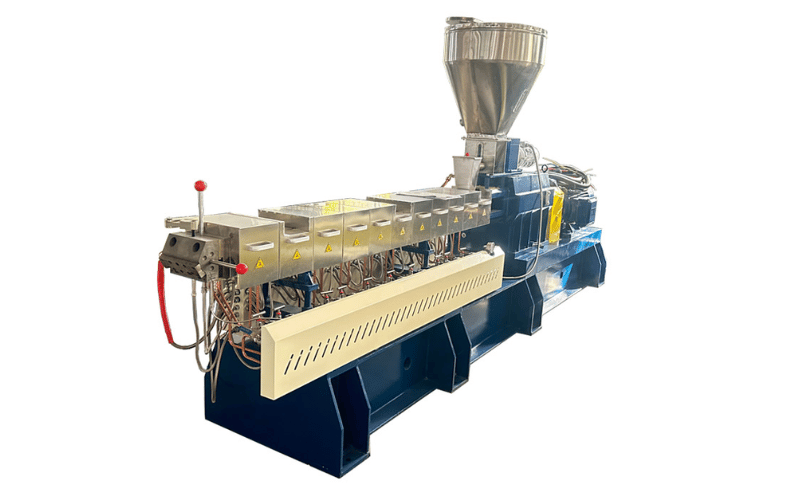
The predominant processing routes are melt blending and dry compounding. In melt blending, the fluoropolymer is brought to its recommended processing domain in a twin-screw or single-screw extruder, with all additives introduced and homogenized at elevated temperatures. In dry blending, the fluoropolymer and additives are blended in the cold granular state; the mixture is subsequently subjected to compaction, frequently followed by a sintering or thermal settling step to achieve inter-particle bonding and property consolidation.
Extrusion Processes for PTFE Compounds
Extrusion plays an integral role in shaping fluoropolymer-based materials, particularly polytetrafluoroethylene (PTFE). Classical melt extrusion is inapplicable to PTFE owing to its exceptionally high thermal transformation temperatures and thermal shear viscosity; thus, specialist extrusion variants are employed. Paste extrusion and ramming extrusion represent the most frequently adopted PTFE shaping strategies.
Paste extrusion begins by super-plasticizing PTFE powder in an elevated-temperature, thixotropic hydrocarbon or aqueous lubricant. The resultant homogenized paste is extruded through a shaped die—commonly tubular, rods, or flat sheets—effectively aligning the polymer region in the die section. Remaining lubricant is thereafter vertically or horizontally sintered, precipitating dimensional crystallization and inter-particle conductivity and tensile coherence, preparatory to end-service applications.
Ram Extrusion: In the ram-extrusion technique, PTFE powder is densely compacted in a cylindrical chamber and subsequently propelled through a die by a mechanically operated ram. Following extrusion, the green body undergoes controlled sintering to develop the required crystalline and mechanical characteristics.
Both ram-extrusion and other comparable techniques yield high-performance PTFE parts that support demanding applications in sectors such as aerospace, aerospace engineering, automotive, and chemical process engineering.
Custom Compounding for Application Optimization
Custom compounding permits the targeted modification of fluoropolymer compositions to satisfy precise technical criteria. By judiciously choosing and combining functional fillers and additives, designers can modulate properties including chemical resilience, dielectric behaviour, and tensile strength.
Selected application illustrations are as follows:
- Aerospace : Fluoropolymers reinforced with glass- or carbon-fibre mats enhance strength and dimensional stability under high-temperature, low-pressure conditions for selected airframe, propulsion and rotorcraft parts.
- Healthcare : Proprietary blends incorporating biocompatible and sterilization-bleed additives guarantee the inert and mechanical integrity required by operator and crew exposed tooling and sealed robotics, as well as implanted prosthetic conforms.
- Microelectronics : Incorporation of conductive fillers, such as low-structured carbon-black or controllable-sized metal-oxide powders, facilitates the manufacturing of fluoropolymer matrix systems that provide hermetic shielding and low-/? transit, driven excess, commercial substrates.
Such customized formulations assure fluoropolymers can continuously and reliably outperform electro- or mechanical tolerances in mission-critical environments.
Applications of Custom PTFE in Various Industries
Fluoropolymers in Chemical Processing
Custom PTFE (polytetrafluoroethylene) continues to be the material of choice in chemical processing environments characterized by aggressive media. Its tolerance to concentrated acids, caustics, and organic solvents facilitates the development of durable linings, gaskets, and sealing elements employed in reactors, heat exchangers, and long-distance pipelines.
Modifiers, such as microglass and carbon particulates, are blended into the basic resin matrix to improve tensile strength and abrasion resistance while limiting thermal expansion. The synergistic effect of enhancement fillers compensates for the typical low mechanical strength of pure PTFE, enabling the material to function reliably over an extended service cycle in elevated pressures and temperatures. Contaminant sequestration within the PTFE matrix is avoided, assuring material compatibility and the maintenance of product quality.
Hygienic and Biopharma Applications
Custom PTFE delivers high reliability in food and pharmaceutical processing by combining cleanliness, chemical purity, and dimensional stability. The low coefficient of friction intrinsic to PTFE results in highly effective food and pharmaceutical gaskets, liners, molds, blenders, and spirals on continuous conveyor systems. Procedures to remove dried viscosity are straightforward and incomplete product yield is markedly minimized.
PTFE medical and biopharma product families, modified for biocompatibility, include multidimensionally changed tubing, stoppering, and sealing components fabricated to International and regional standards. The basic polymer imparts resistance to ionic and saturated steam and high e-beam doses encountered in sterilization cycles, while mechanical flex and high-pressure integrity maintain dimensional reliability and leakage prevention over multiple cycles of thermal or radiation sterilization and product conveyance.
Industrial Uses and Market Trends
Bespoke PTFE continues to find critical footing across aerospace, automotive, and electronics sectors: in aerospace, its blend of low density and elevated-temperature endurance qualifies it as a preferred insulating medium for critical wiring and sensitive components; in automotive, precisely engineered seals, gaskets, and bearings exploit PTFE’s intrinsic low-friction behavior to lower overall system drag and consequently improve fuel consumption metrics.
In the electronics domain, PTFE is valued for its outstanding dielectric performance; it governs signal integrity and attenuation in a suite of high-frequency cabling and integrated circuit architectures. The persistent expansion of the electric vehicle manufacturing ecosystem and the parallel uptake of renewable energy grids furnish a lucrative setting for next-generation PTFE composites, with ongoing formulation work privileging both environmental stewardship and functional excellence.
Contemporaneous market analysis depicts a sustained expansion in the consumption of custom PTFE formulations, a trend underpinned by steadily maturing additive and processing technologies and by a systemic repetition of performance limits set in next-wave industrial and aerospace applications.
AGC and Polyflon: Premier Sources of Fluoropolymer Compounds
AGC’s Fluoropolymer Product Catalog
Accredited as a pre-eminent provider of advanced materials, AGC delivers a multifaceted collection of fluoropolymer offerings engineered for mission-critical sectors. The firm’s suite consists of exceptionally high-performance candidates, including polymers such as ETFE (ethylene tetrafluoroethylene), PTFE (polytetrafluoroethylene), and PFA (perfluoroalkoxy alkane). Their intrinsic attributes—superior resistance to corrosive media, wide-ranging thermal stability, and excellent dielectric strength—render these fluoropolymers indispensable.
AGC’s polymers find utility across a broad spectrum of environments: compounds are employed in chemical-processing reactors, heat- and chemical-resistant automotive fittings, and coaxial or insulating layers within electronics. ETFE sheet and film, lightweight yet remarkably translucent, has gained prominence within architectural skin systems, while PTFE engineered articles provide leak-proof sealing in chemically aggressive zones, including petrochemical and nuclear reactors.
Polyflon’s Specialized Custom-Compound Engineering
Within the same market context, Polyflon devotes its manufacturing competencies to the architecting of custom fluoropolymer composites. Engineers marry a core fluoropolymer (often PTFE or PFA) with carefully screened and qualified fillers, including tough ceramics, metals, and engineered hybrids. The selection and ratio of these modifiers are systematically adjusted to elevate surface hardness, electromechanical or thermal conductivity, and isotropic mechanical strength. The resultant compounds catalyse enduring performance in regimes where standard-grade materials typically falter, including wear strips, low-noise sealing bands, and unmatched thermal-shock seals.
Polyflon continues to distinguish itself through the synthesis of ultra-pure PTFE formulations specifically engineered for semiconductor fabrication. These low-ionic-content polymers mitigate the risk of process contamination while retaining mechanical integrity under prolonged exposure to high-purity gases. Complementing this portfolio is a series of conductive fluoropolymer grades, formulated to provide concurrent thermal management and EMI attenuation for miniaturized electronic assemblies.
Frequently Asked Questions
Q: What is fluoropolymer compounding?
A: Fluoropolymer compounding involves mixing fluoropolymer resins with additives and fillers to enhance their properties and customize them for specific applications. This process enables manufacturers to create materials that meet the unique performance demands of various industries.
Q: What are the common applications of fluoropolymers?
A: Fluoropolymers are widely used in industries such as automotive, electrical, and chemical processing. Their excellent chemical resistance, thermal stability, and low friction properties make them ideal for products like tubing, coatings, and insulation materials.
Q: How does the extrusion process work in fluoropolymer manufacturing?
A: In fluoropolymer manufacturing, the extrusion process melts the fluoropolymer resin and forces it through a die to form specific shapes or profiles. This technique efficiently produces continuous lengths of tubing, sheets, and other components with precise dimensions.
Q: What properties make fluoropolymers suitable for high-temperature applications?
A: Fluoropolymers excel in high-temperature applications due to their exceptional thermal stability, which allows them to withstand extreme heat without degrading. Their chemical resistance and low friction properties further enhance their performance in industries like aerospace and automotive.
Q: What types of fluoropolymers are commonly used in compounding?
A: Common fluoropolymers used in compounding include polytetrafluoroethylene (PTFE), perfluoroalkoxy (PFA), and fluorinated ethylene propylene (FEP). Each type offers unique benefits, such as superior chemical resistance or easier processing.
Q: What role do fillers play in fluoropolymer compounding?
A: Fillers improve properties like stiffness, abrasion resistance, and thermal conductivity during fluoropolymer compounding. They also help reduce costs by partially replacing the more expensive fluoropolymer resin while maintaining the desired performance.
Q: How can fluoropolymer compounding improve mechanical properties?
A: Fluoropolymer compounding enhances mechanical properties by adjusting the formulation of resins and fillers. This customization can improve tensile strength, creep resistance, and overall durability, making the materials suitable for demanding applications.
Q: What are the environmental considerations in fluoropolymer compounding?
A: Environmental considerations in fluoropolymer compounding include using sustainable materials and exploring recycling options for the final products. Manufacturers are increasingly adopting practices to minimize environmental impact while maintaining high performance standards.
Concluding Summary
By every relevant criterion, fluoropolymers have affirmed their stature as the foundational polymer class in contemporary engineering. Their unique property constellation permits sustained service in diverse arenas, equally in handling highly corrosive reagents, in enduring extreme flight ascent conditions, in ensuring food safety, and in advancing miniaturized electronics. Continuous innovation by premier producers—most notably AGC and polyflon—has yielded both off-the-shelf and bespoke solutions, matched to each sector’s dynamic performance and price threshold. As global engineering pushes performance and environmental boundaries, fluoropolymers will, by design, remain the enabling platform, facilitating enhancements in functional efficiency, material longevity, and bespoke task performance.


 English
  Portuguese
  Spanish
  Korean
  Russian
  German