


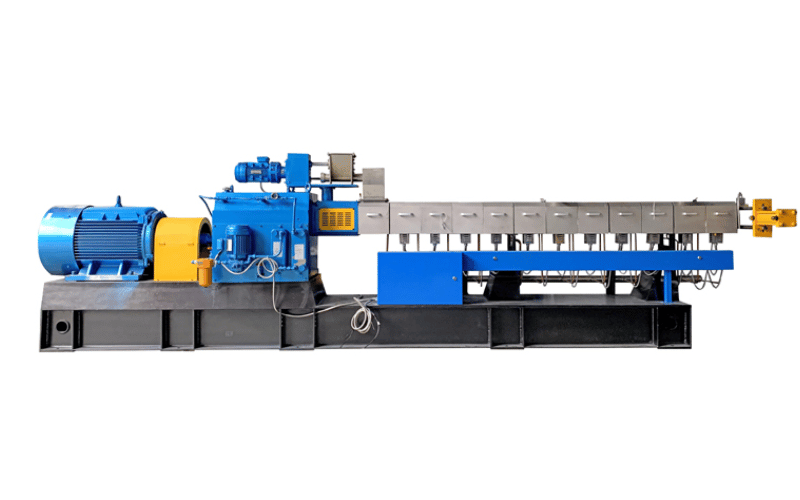
There are various types of extruders available in the market, and one of the most popular options is the twin-screw extruder. Many of you might be curious about whether twin-screw extruders outperform single-screw extruders or which applications twin-screw extruders are best suited for.
This blog will guide you through these questions by providing comprehensive insights into twin-screw extruders and helping you determine if they are the right choice for your specific needs.
What is a twin-screw extruder?
A twin-screw extruder is a type of extrusion equipment designed to process materials by using two intermeshing screws. This design enables better mixing, shearing, and conveying of materials, making it highly effective for applications that require precise control over the extrusion process. Twin-screw extruders are known for their versatility, enabling the handling of a wide range of materials, from plastics and food products to chemicals and pharmaceuticals.
Twin-screw extruders come in various configurations, including co-rotating and counter-rotating designs, and are available in different sizes to suit specific production needs. Their adaptability and efficiency make them a popular choice in industries where consistent quality and performance are critical.
Different types of twin-screw extruders
Based on different configurations and applications, there are several types of twin-screw extruders commonly used in various industries:
Co-Rotating Twin-Screw Extruder
Co-rotating twin-screw extruders have screws that rotate in the same direction. This design is ideal for applications that require high levels of mixing and compounding, such as the production of plastics, food, and pharmaceuticals. The co-rotating motion ensures more effective material distribution and improved heat transfer.
Counter-Rotating Twin-Screw Extruder
In counter-rotating twin-screw extruders, the screws rotate in opposite directions. This configuration is often used for applications requiring gentle material handling, such as PVC pipe and profile extrusion. It provides excellent control over shear and pressure, making it suitable for heat-sensitive materials.
Intermeshing Twin-Screw Extruder
Intermeshing twin-screw extruders feature screws that overlap and interlock, ensuring thorough mixing and consistent material flow. This type is widely used in industries where precision and uniformity are critical, such as in the production of specialty polymers and food products.
Non-Intermeshing Twin-Screw Extruder
Non-intermeshing twin-screw extruders have screws that do not overlap, allowing for higher throughput and reduced wear. These are commonly used in applications where high output and durability are prioritized, such as in the processing of bulk materials.
High-Speed Twin-Screw Extruder
High-speed twin-screw extruders are designed for applications requiring rapid processing and high productivity. They are often used in industries such as packaging and automotive, where efficiency and output are crucial.
Laboratory Twin-Screw Extruder
Laboratory twin-screw extruders are smaller-scale machines designed for research and development purposes. They allow for precise control and testing of materials, making them essential for product innovation and formulation development.
Each type of twin-screw extruder is tailored to specific needs, ensuring optimal performance and efficiency for a wide range of applications.
How Does a Twin-Screw Extruder Work?
Twin-screw extruders are highly efficient and versatile machines designed to handle complex material processing tasks. Their operation is centered around two intermeshing screws housed within a barrel, which work together to deliver precise mixing, conveying, and shaping of materials. Let me break it down for you:
The screws in a twin-screw extruder are engineered to maximize material interaction. By adopting a co-rotating or counter-rotating design, the screws create a controlled environment where materials are subjected to shear, compression, and mixing forces. This ensures that additives, fillers, or other components are evenly distributed throughout the base material.
As the material moves through the extruder, it undergoes a series of processes. First, it is fed into the barrel, where the screws begin to convey it forward. Along the way, the material is heated, melted, and mixed. The intermeshing screws act like a sieve, breaking down agglomerates and ensuring uniformity.
For applications requiring precise control, the screws can be customized with different elements—such as kneading blocks or conveying sections—to optimize the process. This modularity allows twin-screw extruders to handle a wide range of materials, from heat-sensitive polymers to abrasive compounds.
At the final stage, the material is shaped and extruded through a die, forming the desired product. The efficiency of this process is further enhanced by the ability to control parameters like temperature, pressure, and screw speed, ensuring consistent quality and performance.
Whether you’re compounding, devolatilizing, or processing specialty materials, the twin-screw extruder’s ability to combine multiple functions in a single machine makes it an indispensable tool in modern manufacturing.

What Are the Advantages of Twin-Screw Extruders?
For industries with demanding production requirements, such as plastics, food processing, and pharmaceuticals, twin-screw extruders have been designed and refined to meet these challenges head-on. Their unique design and functionality offer a range of advantages, making them a preferred choice for many applications. Here’s why they stand out:
- Superior Mixing and Homogenization
The intermeshing screws provide exceptional mixing capabilities, ensuring uniform distribution of additives, fillers, and other components, even in complex formulations. - High Throughput with Consistent Quality
Twin-screw extruders can handle high production volumes without compromising on the consistency or quality of the output, making them ideal for large-scale operations. - Customizable Screw Configurations
With modular screw elements, you can tailor the extruder to suit specific materials and processes, whether it’s compounding, devolatilization, or reactive extrusion. - Precise Process Control
Advanced control over parameters such as temperature, pressure, and screw speed enables fine-tuning, ensuring optimal performance for heat-sensitive or shear-sensitive materials. - Versatility Across Applications
From plastics and food to specialty chemicals and pharmaceuticals, twin-screw extruders can handle a wide range of materials and processes with ease. - Energy Efficiency and Cost-Effectiveness
Modern twin-screw extruders are designed to maximize energy efficiency, reducing operational costs while maintaining high productivity. - Reduced Material Degradation
The ability to control shear and residence time minimizes material degradation, preserving the integrity of sensitive compounds.
With their larger processing capacity, adaptability, and precision, twin-screw extruders are a powerhouse in the manufacturing world, capable of meeting the most demanding production needs.
Which Industries Are Twin-Screw Extruders Mainly Used For?
Twin-screw extruders are incredibly versatile and find applications across a wide range of industries, including:
- Plastics and Polymers
Used for compounding, blending, and pelletizing materials like thermoplastics, elastomers, and bioplastics. - Food and Beverage
Ideal for producing snacks, cereals, pasta, and pet food, thanks to their precise control over mixing and cooking processes. - Pharmaceuticals
Employed in the production of drug formulations, hot-melt extrusion, and controlled-release medications. - Chemicals and Petrochemicals
Used for processing specialty chemicals, masterbatches, and additives with high precision. - Recycling
Essential for reprocessing and recycling plastics, turning waste materials into reusable pellets. - Construction Materials
Applied in the production of wood-plastic composites, PVC profiles, and other building materials. - Adhesives and Sealants
Used for compounding adhesives, sealants, and other high-viscosity materials.
Twin-screw extruders are a cornerstone of modern manufacturing, offering unmatched flexibility and efficiency across these diverse industries.
How to Select the Most Suitable Twin-Screw Extruder?
Five critical factors influence the selection of a twin-screw extruder. It’s important to carefully review the following considerations:
The first thing you need to evaluate is the material you’ll be processing. This determines the screw design, barrel configuration, and whether you need a co-rotating or counter-rotating extruder. Next, think about the specific process requirements—whether it’s compounding, devolatilization, or reactive extrusion, as this will guide the customization of screw elements.
Don’t forget to consider the production scale and throughput you need. A high-throughput operation may require a larger extruder with higher torque, while smaller-scale production might benefit from a compact model. Additionally, precision and control are crucial, especially for industries like pharmaceuticals or food, where consistent quality is non-negotiable.
When you’ve considered all these factors, you’ll have a clearer idea of which twin-screw extruder is best suited for your application.
It’s essential to keep in mind that there isn’t always a straightforward answer to the question of which extruder is ideal. The right choice will depend on the unique specifications of your project. Take the time to assess your needs thoroughly, and consult with experts if necessary to ensure you select the most suitable equipment for your operation.
Conclusion
Twin-screw extruders have their own unique advantages and benefits, and when applied to the right industries, they can deliver exceptional performance in material processing. Thanks to their dual-screw design, twin-screw extruders offer superior mixing, precise control, and versatility, making them a preferred choice for many applications.
With decades of experience in the extruder equipment industry, we specialize in providing tailored solutions for your extrusion needs. From selecting the right extruder to optimizing your production process, we are here to guide you every step of the way.
We not only offer high-quality twin-screw extruders but also provide expert advice and support to ensure you get the most out of your equipment. If you have any questions or need assistance with extrusion, please don’t hesitate to reach out to us.


 English
  Portuguese
  Spanish
  Korean
  Russian
  German