


The cable extruder is a versatile and widely used piece of equipment in the manufacturing industry, particularly for producing insulated wires and sheathed cables. This powerful machine plays a crucial role in transforming raw polymer materials into protective coatings for a wide range of products, from power lines to advanced fiber optic components.
But what exactly is a cable extruder? How does it work? And what are its applications? In this blog post, we’ll explore the inner workings of the cable extruder, delving into its key elements, operational principles, and the diverse applications that leverage its capabilities.
What is a Cable Extruder?
A cable extruder is a specialized piece of equipment that applies a continuous coating of polymer, such as insulation or sheathing, over a conductive wire or core. Unlike general-purpose extruders that create standalone profiles, the cable extruder is part of an integrated line that feeds a core material through a crosshead die. This unique configuration is essential for manufacturing insulated wires and cables.
The cable extruder’s design allows for precise application of molten polymer onto a moving conductor. As the core passes through the crosshead die, the extruder melts and pumps polymer at a consistent rate, forming a seamless, concentric layer around it. This feature is particularly beneficial for creating high-performance cables where uniform insulation thickness is critical for electrical safety and performance.
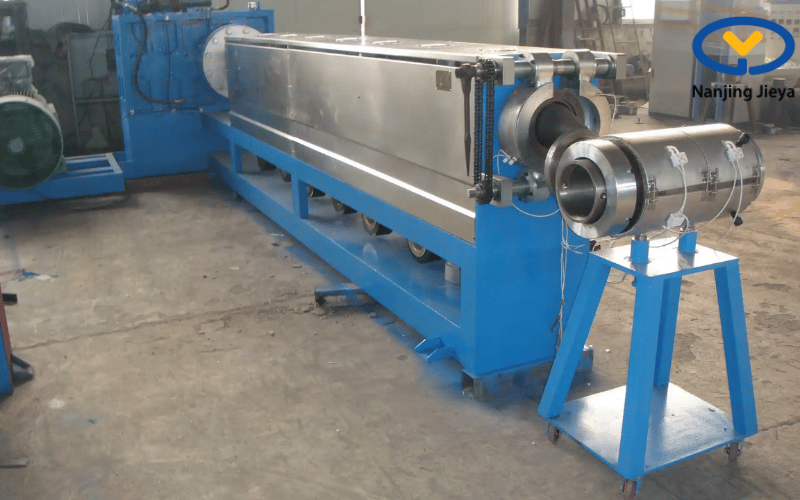
The Significance of Cable Extruders in Wire and Cable Manufacturing
In wire and cable manufacturing, the cable extruder plays a vital role in melting, pumping, and applying polymer coatings onto a central conductor. The machine’s screw design generates the pressure needed to force molten material through a crosshead die, ensuring a uniform and concentric layer of insulation or sheathing is applied. This results in a high-quality, protected cable suitable for demanding applications, such as power, communication, and fiber-optic lines.
One of the most common applications of the cable extruder is in the production of PVC (polyvinyl chloride) and PE (polyethylene) insulated wires. Cable extrusion lines are designed to handle the unique properties of these versatile materials, providing precise temperature control and stable melt flow to ensure consistent coating thickness and electrical integrity.
Understanding the Difference Between Standard Extruders and Cable Extruders
Compared to standard extruders that produce standalone products like pipes or sheets, cable extruders offer several unique advantages for wire coating. They are known for their precision in applying a perfectly concentric layer of insulation, which is essential for maintaining consistent electrical properties and safety. Additionally, cable extrusion lines are designed for high-speed, continuous operation and seamlessly integrate with conductor payoff and cable take-up systems.
The difference between standard and cable extruders lies in their design and operational principles. Standard extruders typically use an inline die to shape the molten polymer into its final form. In contrast, cable extruders use a specialized crosshead die that allows a wire or cable core to pass through it perpendicularly while molten polymer is applied around it. This design offers better control over wall thickness and concentricity, enabling the precise coating of conductors at high speeds.
Key Elements of a Cable Extruder
The cable extruder is a complex piece of equipment with several key components that contribute to its efficient operation and performance in applying polymer coatings. One of the most crucial elements is the screw itself, which is designed to deliver melt reliably.
1. Screws
- Single-Screw Design: Most cable extruders utilize a single screw, as the primary goal is consistent melting and pressure generation rather than intensive mixing. The design is optimized for specific polymers like PVC or PE.
- Barrier Screws: These are common in cable extrusion. They feature a secondary flight that separates the melted polymer from the solid pellets, leading to more efficient melting and a more homogenous melt temperature, which is critical for consistent coating.
- High L/D Ratio: Cable extruder screws typically have a high length-to-diameter (L/D) ratio, often 25:1 to 30:1, to ensure the polymer is fully melted and pressurized before reaching the die.
2. Barrel
The screw is encased within a heated barrel, which provides the necessary temperature control for melting and processing the insulation material. The barrel is divided into multiple zones, each with independent heating and often air or water cooling, allowing for precise management of the temperature profile along the extrusion path to prevent overheating.
3. Feed Zone
This zone is where the raw material, typically pellets or granules of PVC, PE, or XLPE, is introduced into the extruder. Its design ensures a smooth, consistent feed of material into the screw flights, the first step toward a stable output.
4. Melting and Conveying Zones
As the material moves along the screw, it encounters these zones where the combination of heat from the barrel and shear forces from the screw’s rotation gradually melts and plasticizes the polymer. The screw design ensures the material is conveyed steadily as it transforms into a uniform melt.
5. Kneading and Mixing Zones
While less intensive than in twin-screw extruders, cable extruder screws often include distributive mixing sections. These zones feature elements such as fluted or finned sections to ensure thorough homogenization of the melt and uniform dispersion of additives, such as color masterbatch or UV stabilizers.
6. Venting and Vacuum Zones
Cable extruders, particularly those processing materials such as nylon or specific polyethylenes, may incorporate venting or vacuum zones. These allow for the removal of moisture or other volatile components from the melt, which is crucial for preventing porosity and ensuring a high-quality, void-free insulation layer.
7. Die
The die is the final and most specialized component. In cable extrusion, this is a crosshead die in which the molten polymer is directed at a 90-degree angle to coat the wire or cable core as it passes through the center. The tooling within the die shapes the molten polymer into a concentric layer of insulation or sheathing.
By understanding the functions and interactions of these key elements, including the specialized screw designs and the critical crosshead die, manufacturers can optimize the cable extruder’s performance and achieve consistent, high-quality insulation results for a wide range of wire and cable products.
How Does a Cable Extruder Work?
The working principle of a cable extruder is based on its unique design, which features a specialized screw and a crosshead die to apply a continuous polymer coating to a moving conductor. This configuration plays a crucial role in efficiently insulating and sheathing wires and cables. Let’s discuss how the cable extruder works step by step.
1. Material Feeding and Initial Processing
The extrusion process begins by introducing the raw insulating or sheathing material, typically polymer pellets like PVC or PE, into the barrel through a hopper. This ensures a consistent, controlled flow of material onto the rotating screw, the first step toward achieving a stable melt output.
2. Conveying and Compression
As the screw rotates, it conveys the raw material toward the end of the barrel. During this process, the screw’s design compresses the material, removing air and generating initial heat through friction. This prepares the polymer for a uniform and efficient melting phase.
3. Melting and Plasticization
As the material progresses along the screw, the combination of heat from the heated barrel and the shear forces from the screw’s rotation gradually melts and plasticizes the polymer. This process converts the solid pellets into a homogeneous molten mixture with the proper viscosity for coating.
4. Coating the Cable Core
The screw then pumps the molten plastic mixture towards a specialized crosshead die. Simultaneously, the bare wire or cable core is fed through the center of this die. The die directs the molten polymer to flow around the conductor, forming a uniform, concentric layer of insulation or sheathing.
5. Cooling and Calibration
As the newly coated cable emerges from the die, it immediately enters a long cooling trough, typically filled with water. This process rapidly cools and solidifies the polymer coating, locking in its shape and dimensions. In-line measurement tools monitor the diameter and concentricity to ensure the final product meets precise specifications.
The cable extruder’s unique design, featuring a crosshead die and a precisely controlled line speed, makes it highly efficient for applying consistent, high-quality protective layers to conductors. The ability to maintain tight tolerances on coating thickness is critical to the machine’s role in producing safe and reliable cables for countless industrial applications.
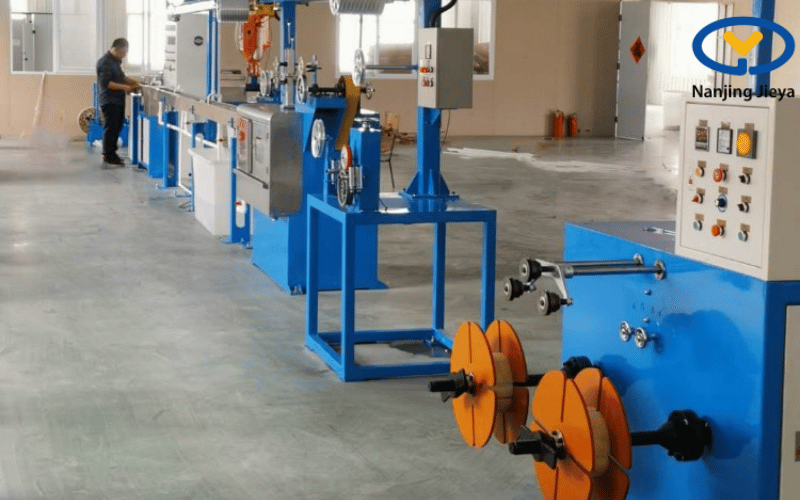
Advantages of Cable Extruders
Cable extruders offer several distinct advantages over other manufacturing methods, making them the preferred choice for producing high-quality insulated wires and sheathed cables. Let’s explore some of the key benefits that cable extruders provide.
- Superior Coating and Insulation Quality: Cable extruders excel at applying a perfectly uniform, concentric polymer layer around a conductor. This precision ensures consistent electrical insulation, prevents weak spots, and guarantees the safety and reliability of the final product.
- High Output Rates and Production Efficiency: Enabled by the continuous nature of the process and seamless integration with pay-off and take-up systems, cable extrusion lines can operate at very high speeds. This allows for massive production volumes and increased manufacturing efficiency.
- Versatility in Processing Materials: These extruders can handle a wide range of insulating and sheathing materials, from common polymers such as PVC and PE to high-performance compounds such as XLPE and fluoropolymers, adapting to various application demands.
- Precise Temperature Control: With multiple, independently managed heating and cooling zones along the barrel, cable extruders provide the tight temperature control required for processing various polymers. This prevents material degradation and ensures a stable melt for consistent coating quality.
- Enhanced Durability and Performance: The extrusion process creates a seamless, protective layer that shields the cable core from moisture, abrasion, chemicals, and environmental stress. This significantly enhances the durability and long-term performance of cables in various demanding environments.
- Cost-Effectiveness in Production: The combination of high-speed operation, efficient material use, and low labor requirements makes cable extrusion a highly cost-effective method for producing large volumes of high-quality, reliable cables.
Types of Cable Extruders
While cable extruders share many standard features and principles, they come in different types designed to cater to specific applications and material requirements. Two main categories of cable extruders are used in the wire and cable industry:
1. Single-Screw Cable Extruders
This type of extruder features a single rotating screw and is the most common design in the industry for its simplicity and reliability.
- Single-screw configurations are highly effective for processing pre-compounded materials like standard PVC and PE, where the primary need is consistent melting and pressure.
- They are known for their cost-effectiveness and efficiency, making them suitable for high-volume production of general-purpose wires and cables.
- They are commonly used for basic insulation and sheathing applications where intensive mixing of additives during the extrusion process is not required.
2. Twin-Screw Cable Extruders
As the name suggests, this more advanced type of extruder features two intermeshing screws, providing superior mixing capabilities.
- The screws can be co-rotating or counter-rotating, generating high shear forces for excellent mixing and homogenization.
- The design allows for exceptional dispersion of additives, fillers, and colorants directly during the extrusion process, which is critical for creating high-performance and specialty compounds.
- Twin-screw cable extruders are particularly useful for processing challenging materials or creating compounds with specific properties, such as flame retardancy or enhanced durability.
- They are commonly employed in the production of high-performance cables where precise material formulation and superior consistency are essential for meeting demanding specifications.
The choice between a single-screw and a twin-screw cable extruder depends on factors such as material properties, desired product characteristics, the complexity of the polymer compound, and production volumes. Manufacturers often collaborate with extruder suppliers to select the most suitable type and configuration for their specific applications, ensuring optimal performance and product quality.
Applications of Cable Extruders
Cable extruders are versatile machines that find applications across a wide range of industries, thanks to their ability to efficiently apply protective polymer coatings and produce high-quality, reliable cables. Let’s explore some of the key applications of cable extruders:
1. Power Cables
Cable extruders play a vital role in the energy sector, where they are used for the insulation and sheathing of high-voltage, medium-voltage, and low-voltage power cables. They are employed in applying thick, void-free layers of materials like XLPE (cross-linked polyethylene) to conductors, which is critical for electrical safety and performance in power transmission and distribution grids. Cable extruders also apply durable outer jackets that protect these essential cables from environmental damage.
2. Communication Cables
The high-precision coating capabilities of cable extruders make them indispensable for manufacturing communication cables. They are used to apply protective layers to delicate fiber optic strands, ensuring their integrity for high-speed data transmission. The process is also used for producing coaxial cables with consistent impedance and data cables like Cat5e and Cat6, where uniform insulation is key to signal quality.
3. Automotive Cables
In the automotive industry, cable extruders are used to produce the vast network of wires used in vehicles. They apply insulation materials that ensure durability and high resistance to heat, oil, and abrasion. From battery cables to sensor wires, the extruded coatings must meet strict safety and performance standards, protecting the vehicle’s complex electrical systems from the demanding under-hood environment.
4. Industrial Cables
Cable extruders find extensive applications in producing robust cables for harsh industrial environments. They apply protective sheathing made from materials like PVC, polyurethane, or thermoplastic elastomers to shield cables used in factories, mining operations, and chemical plants. These extruded jackets provide resistance to chemicals, mechanical stress, and extreme temperatures, ensuring operational reliability.
5. Specialty Cables
Cable extrusion contributes significantly to the production of specialty cables designed for specific performance requirements. This includes extruding advanced materials for fire-resistant cables that maintain circuit integrity during a fire, applying UV-resistant jackets for outdoor applications, or creating waterproof sheathing for subsea or buried cables. The versatility of the process allows for the creation of cables tailored to almost any unique challenge.
With their precision, efficiency, and ability to handle a wide range of materials, cable extruders remain indispensable in modern manufacturing, driving innovation and enabling the production of high-performance cables for nearly every industry.
Final Thoughts on Cable Extruders
The cable extruder is a remarkable piece of machinery that has revolutionized manufacturing processes across the global connectivity infrastructure. From power grids and telecommunications to automotive and industrial sectors, these versatile machines have proven their worth through their excellent coating precision, high output rates, and ability to ensure high-quality, durable, and reliable cables.
Whether you’re looking to produce high-quality insulated wires, coat sensitive fiber optics with protective sheathing, or explore advanced materials for specialty applications, a cable extruder can be the key to unlocking new possibilities for your business.
Visit our website to learn more about Cable Extruders. We also offer Twin Screw Extruders as part of your comprehensive solution. If you are looking for a Cable Extruder machine and need a guide to choose a suitable instrument for your specific need, don’t hesitate to get in touch with us now.
FAQ (Frequently Asked Questions)
1. What are the key advantages of using a dedicated cable extruder over a standard one?
A dedicated cable extruder uses a specialized crosshead die to apply a perfectly concentric layer of insulation or sheathing around a conductor. This precision ensures consistent electrical properties and safety. Unlike standard extruders, cable extrusion lines are integrated for continuous, high-speed operation, which boosts overall production efficiency for wire and cable manufacturing.
2. How does a cable extruder improve product quality and consistency?
The crosshead die design ensures that the molten polymer is applied uniformly around the moving wire core, which is critical for maintaining consistent wall thickness and concentricity. The system’s precise temperature control prevents material degradation, while specialized screw designs deliver a stable, homogenous melt. This level of process control results in a reliable, high-quality cable free from weak spots or defects.
3. Our process involves high-performance materials like fluoropolymers. Is a single-screw cable extruder a suitable choice?
Yes, a single-screw extruder is the industry standard for most cable extrusion applications, including those using high-performance materials. For challenging polymers, the screw and barrel are often made from corrosion-resistant alloys. Specialized screw designs, such as barrier screws, are used to ensure efficient melting and a stable melt temperature, which is crucial for processing materials like fluoropolymers or XLPE without degradation.
4. How does a cable extruder support the production of different types of cables?
Cable extruders are highly versatile. By changing the tooling in the crosshead die and adjusting line speed, manufacturers can produce a vast range of cable sizes and types. The machine can process various polymers, from flexible PVC for consumer electronics wires to rigid, durable compounds for high-voltage power cables. This flexibility allows one extrusion line to serve multiple markets, including automotive, telecommunications, and industrial applications.
5. What is the potential ROI when investing in a high-speed cable extrusion line?
The return on investment for a cable extrusion line is driven by several factors, including extremely high throughput, improved product quality (meeting tight tolerances), and reduced scrap rates. The efficiency of a continuous, automated line also leads to lower labor costs per meter of cable produced. While the initial investment is significant, the increased productivity and material consistency result in a fast ROI, especially for high-volume production.


 English
  Portuguese
  Spanish
  Korean
  Russian
  German