


PVC extrusion is a vital manufacturing technology that combines material processing with precise shaping to create a vast range of products. It refers to the operational process of melting and forming a PVC compound into a continuous profile, such as pipes, window frames, or siding.
This technology is critical to producing durable, cost-effective goods for the construction, automotive, and consumer industries. In this blog, we will explore the fundamental principles of PVC extrusion, from the unique challenges of processing this heat-sensitive polymer to the factors that influence selecting the best extruder for your specific application.
PVC Extrusion Principles
PVC extrusion uses a specialized plasticizing system composed of a screw and a barrel to process this heat-sensitive polymer continuously. Given PVC’s unique tendency to degrade under high heat and shear, each zone on the extruder barrel is independently controlled for temperature. At the same time, screw design dictates material residence time and shear strength. This precise control is critical to avoid burning the material.
The PVC compound, typically a dry-blend powder containing resin, stabilizers, lubricants, and other additives, is fed into the screw from a hopper. The material is then transported through distinct zones to complete a series of essential operations: solid conveying, low-shear melting and gelation, pressurized homogenization, optional devolatilization to remove trapped air or moisture, and finally, melt conveying and shaping through a die.
The traditional extrusion process for polymers such as polyolefins relies heavily on shear and friction to melt the material. This approach is too harsh for PVC, which can rapidly degrade. PVC extrusion, therefore, requires a different philosophy. It is a gentler process focused on conductive heat transfer from the barrel and carefully managed shear to achieve a uniform melt without causing thermal decomposition. This makes it fundamentally different from processing more stable polymers.
PVC has a very high melt viscosity and a narrow processing window between melting and degradation. A general-purpose extruder would either fail to melt the material properly or would quickly burn it. PVC extruders, most often counter-rotating twin-screw machines, are designed to solve this. They provide positive-displacement conveying, ensuring consistent output and residence time. The low-shear screw design gently works the material, ensuring it reaches a fully gelled state without excessive frictional heat, combining the delicate melting process with shaping into a continuous operation.
The formulation dictates the final properties of a PVC profile, but the extrusion process makes them possible. The process must deliver just enough energy to achieve complete fusion of the PVC particles, but not so much that it triggers degradation. For PVC extruders, rheology, precise temperature control, and low-shear mixing play the most critical roles in the final product quality. These factors are all interconnected and must be carefully balanced to produce high-quality, durable profiles.
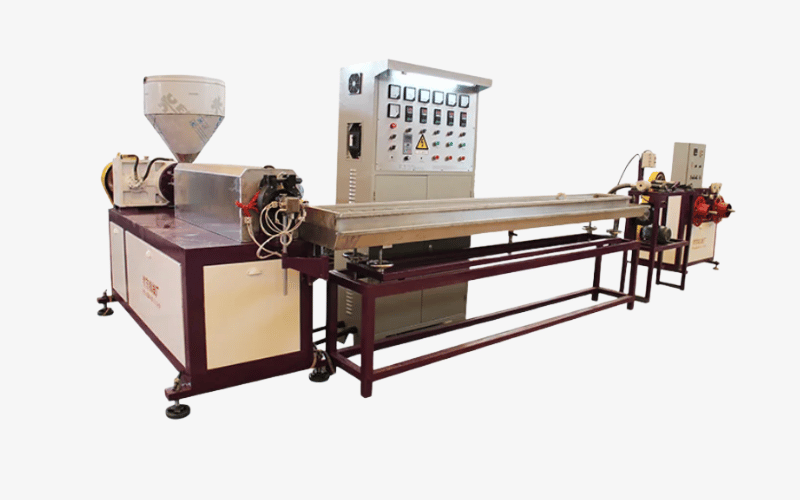
Applications of PVC Extrusion
PVC extrusion has been widely used in manufacturing construction materials, consumer goods, and industrial components, playing a critical role in modern production. This technology is essential for creating everything from basic pipes to complex window profiles and medical tubing with high precision and cost-effectiveness.
The key applications of PVC extruders are as follows:
- Production of Pipes, Profiles, and Sheets: Manufacturing rigid PVC items like plumbing pipes, window frames, siding, and flat sheets used in signage and construction.
- Manufacturing of Cables and Wires: Coating electrical wires and cables with flexible PVC for insulation and protection due to its excellent dielectric properties.
- Creation of Flooring and Wall Panels: Producing durable and decorative vinyl flooring planks and interlocking wall panels for residential and commercial buildings.
- Processing of Rigid and Flexible PVC: Creating a vast range of products, from rigid packaging films and credit cards to flexible tubing, hoses, and weather stripping.
- Recycling and Reprocessing of PVC Materials: Reclaiming post-industrial and post-consumer PVC scrap, such as old pipes and window frames, and turning it back into usable raw material.
What Is The Best PVC Extruder?
Equipment requirements for PVC extruders:
1. Sufficient Melting and Processing Time
The extruder must provide enough time for the PVC compound to melt and achieve complete gelation. Additionally, there must be adequate time to remove any trapped air or moisture, which requires the extruder to have a sufficient length-to-diameter (L/D) ratio for the specific application.
2. Narrow Residence Time Distribution
The material’s residence time distribution should be narrow to ensure uniform processing and prevent thermal degradation. It is crucial to avoid some material overheating due to extended residence times, while other material remains underprocessed and not fully fused.
3. Excellent Venting Performance
During PVC extrusion, it is sometimes necessary to remove trapped air from the powder feed or moisture from the compound. This typically requires achieving a vacuum through vent ports without causing the extruder to overflow (vent flow).
4. Low-Shear Conveying and Mixing Capability of the Screw
The screw must have strong conveying capabilities but apply low shear. Since PVC is heat-sensitive and generates significant frictional heat, the screw design must gently convey and mix the material without causing it to burn or degrade.
5. Good Heat Transfer Function
During PVC extrusion, any frictional heat released must be quickly removed from the system to prevent polymer degradation. Therefore, the extruder barrel and often the screws should have excellent cooling capabilities to maintain precise and stable temperature control.
The machines used for PVC extrusion include single-screw and twin-screw extruders. A comparison of the two is as follows:
|
Twin Screw Extruder (Counter-Rotating) |
Single Screw Extruder |
|
|---|---|---|
|
Advantages |
Low shear, precise temperature control, positive displacement for stable output, excellent for processing dry-blend powders. |
Simple design, low price, suitable for processing pre-pelletized PVC compounds. Low energy consumption, low noise, stable operation, and long life. |
|
Disadvantages |
The structure is more complex, and the price is higher than that of a single screw. |
Material transportation relies on friction, making it unsuitable for low-density powders. High shear can cause degradation of rigid PVC. |
|
Scope of use |
The industry standard for high-volume, high-quality extrusion of rigid PVC profiles, pipes, and siding directly from powder blends. |
Suitable for processing flexible PVC or pelletized rigid PVC compounds where high shear is less of a concern. |
The most popular and practical option today is the counter-rotating twin-screw extruder
Extruders required for different PVC applications are specifically designed. Due to the heat-sensitive nature of rigid PVC, profile and pipe extrusion processes almost exclusively use counter-rotating twin-screw extruders because they have the following characteristics:
- Low-shear mixing function to prevent degradation.
- Highly efficient heat removal function to precisely control melt temperature.
- Positive displacement conveying for stable output and pressure.
- Narrow residence time distribution.
While co-rotating twin-screw extruders are excellent for compounding, they are generally not used for PVC profile extrusion.
Application of co-rotating twin-screw extruders in PVC processing
They are often used in applications that require high-intensity mixing, such as compounding PVC with fillers or other additives to create pelletized raw materials.
Compared with counter-rotating extruders, co-rotating extruders provide much higher shear and more intensive dispersive mixing. This is advantageous when blending PVC resin with stabilizers, plasticizers, and fillers to create a homogeneous compound. However, this high shear generates too much frictional heat for direct profile extrusion of unplasticized PVC (PVC-U).
The design of co-rotating extruders is optimized for mixing and devolatilization, which is ideal for compounding but can easily overheat and degrade a rigid PVC formulation during shaping.
While PVC compounding can use co-rotating twin-screw extruders to produce pellets, these extruders are unsuitable for direct extrusion of rigid profiles. Counter-rotating twin-screw extruders are the industry standard for their gentle processing, precise temperature control, and stable output, making them the best choice for a wide range of PVC profile and pipe applications. Ultimately, the best PVC extruder depends on whether you are compounding pellets or extruding a final product.
Choosing Between Co-Rotating and Counter-Rotating Twin Screw Extruders
Co-rotating twin-screw extruders are often favored for their efficient mixing, improved temperature control, and versatility, making them well-suited to a broader range of PVC compounding applications.
In contrast, counter-rotating twin screw extruders are often used in applications that require low shear and better control of material residence time. Compared with co-rotating extruders, counter-rotating extruders provide lower shear. This is advantageous in PVC extrusion processes where high shear may cause premature reaction or degradation of sensitive materials. Although counter-rotating extruders provide adequate distributive mixing, they are generally less effective than co-rotating extruders in dispersive mixing. This means they may not be well-suited for reactions that require thorough dispersion of the reactants.
The design of counter-rotating extruders enables better control of residence time, which is essential for reactions that require precise timing to avoid over- or under-reaction. While PVC extrusion can use counter-rotating twin-screw extruders, compounding is less common due to their lower shear mixing and poorer dispersive mixing capabilities. Co-rotating twin-screw extruders are often favored for their efficient mixing, improved temperature control, and versatility, making them better suited for a broader range of compounding applications. However, for specific processes that require low shear and precise residence time control, counter-rotating extruders remain a viable option. Exactly which machine is the best PVC extruder depends on your specific needs.


 English
  Portuguese
  Spanish
  Korean
  Russian
  German