


A recycled plastic extruder is a key technology in sustainable manufacturing, combining material recovery with high-quality processing. It refers to the operational process of melting, filtering, and pelletizing post-consumer or post-industrial plastic waste into reusable raw materials.
This process is vital for the circular economy, transforming waste streams into valuable resources. In this blog, we will explore the fundamental principles of recycled plastic extrusion, from its core mechanics to the factors that influence selecting the best extruder for your specific recycling needs.
Recycled Plastic Extrusion Principles
Recycled plastic extrusion uses a specialized plasticizing system, consisting of a screw and a barrel, to continuously process waste materials. Leveraging the extruder’s unique ability to handle diverse, often contaminated feedstocks, each zone of the extruder barrel is independently controlled for temperature, material residence time, and shear strength to ensure optimal processing conditions.
Various forms of plastic waste, such as washed flakes, regrind, or densified agglomerates, are fed into the screw from the primary hopper or side feeders. The material is transported through specific zones to complete a series of essential operations: solid conveying, pressurized melting, intensive mixing, filtration, melt pressurization, devolatilization of moisture and volatiles, and finally, pelletizing or shaping.
The traditional extrusion process typically starts with virgin pellets, melting and shaping them through predictable physical changes. Recycled plastic extrusion, however, faces greater challenges. It must manage material degradation, inconsistent bulk densities, and the presence of contaminants like paper, wood, or other polymers. Unlike standard extrusion, which focuses mainly on melting and shaping, recycling extrusion involves restoring the material’s properties through homogenization and degassing, effectively reversing the plastic’s “end-of-life” state.
The viscosity of recycled plastics can vary significantly due to prior thermal history and degradation. A standard single-screw extruder often struggles with these inconsistencies, leading to surging or poor mixing. Recycled plastic extruders, particularly twin-screw systems, solve this by providing superior mixing and surface renewal. The screw and barrel system reduces the viscosity of the heterogeneous melt, intimately mixes it to smooth out variations, and integrates the reclamation process with high-efficiency filtration and degassing into a complete, continuous operation.
While the fundamental laws of polymer rheology remain the same, processing recycled material requires a more robust approach. The extruder must actively manage heat transfer and shear to prevent further degradation while ensuring enough energy is applied to homogenize the mixture. For recycled plastic extruders, the interplay of filtration, vacuum venting, and dispersive mixing plays a key role in the final pellet quality, turning variable waste into consistent, high-value raw material.
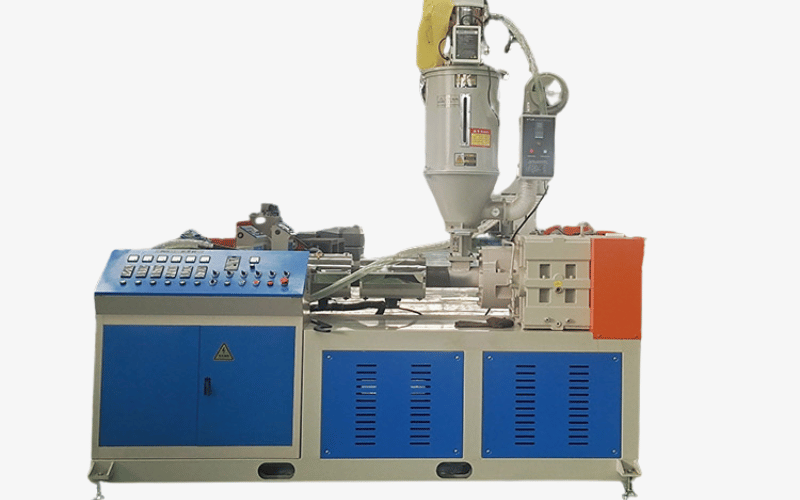
Applications of Recycled Plastic Extrusion
Recycled plastic extrusion has been widely used to process post-consumer and post-industrial waste, playing a critical role in advancing a circular economy. This technology is essential for material reclamation, compounding, and producing high-value recycled plastics for a new life.
The key applications of recycled plastic extruders are as follows:
- Reprocessing of Post-Consumer Waste: Transforming sorted plastic waste, such as bottles, films, and packaging, into clean, uniform pellets for reuse.
- Production of Recycled Pellets: Creating high-quality raw materials from plastic scrap that can compete with virgin resins in various manufacturing processes.
- Manufacturing Eco-Friendly Products: Directly producing items like composite lumber, fencing, pipes, and automotive parts from recycled feedstock.
- Processing of Engineering Plastics: Reclaiming high-performance industrial plastics from sources like automotive or electronic waste for re-use in demanding applications.
- Compounding and Blending: Upcycling lower-grade plastics by mixing them with virgin materials or additives to meet specific performance standards for new products.
What Is The Best Recycled Plastic Extruder?
Equipment requirements for recycled plastic extruders:
1. Sufficient Melting and Processing Time
The extruder must provide enough time for the materials to melt, filter, and homogenize. Additionally, there must be adequate time in the devolatilization section to remove moisture and contaminants from the product, which requires the extruder to have a large length-to-diameter (L/D) ratio.
2. Narrow Residence Time Distribution
The residence time distribution of the material should be narrow to ensure consistent processing and prevent further degradation of the recycled material. It is crucial to avoid overheating some materials due to extended residence times while other materials are underprocessed.
3. Excellent Venting Performance
During recycling, it is necessary to remove moisture, trapped air, ink volatiles, and other contaminants from the material. This typically requires achieving high vacuum levels through multiple venting ports within a short period without causing the extruder to overflow (vent flow).
4. Strong Conveying and Shearing Capability of the Screw
The screw must have strong conveying and shearing capabilities to handle inconsistent feedstocks. Since the viscosity and bulk density of recycled plastic can vary widely, the screw’s conveying capacity must be robust. Intense shearing is also essential for breaking down contaminants and ensuring thorough mixing.
5. Good Heat Transfer Function
During the processing of recycled plastics, the frictional heat released from high shear must be quickly removed from the system to prevent polymer degradation. Therefore, the extruder barrel should have excellent cooling capabilities to maintain precise temperature control.
The machines used for recycling can be single-screw extruders, twin-screw extruders, and reciprocating pin screw extruders. A comparison of the three is as follows:
|
Twin Screw Extruder |
Single Screw Extruder |
Reciprocating Pin Screw Extruder |
|
|---|---|---|---|
|
Advantages |
High efficiency, precise control, multi-function, excellent mixing for homogenization, and superior devolatilization and filtration capabilities. |
Simple design, low price, suitable for processing clean, uniform regrind—low energy consumption, low noise, stable operation, and long life. |
Features uniform shearing and high dispersion, combining the advantages of single and twin screw extruders for specific applications. |
|
Disadvantages |
The structure is complex, and the price is high. The complex flow in the meshing area is difficult to analyze accurately. |
Material transportation relies on friction, limiting feeding performance with light, fluffy materials and poor mixing for contaminated or mixed plastics. |
Its complexity may affect the ease of operation and increase maintenance costs, making it less common in recycling. |
|
Scope of use |
Suitable for applications requiring high-quality pellets from contaminated or mixed plastic waste. |
Suitable for reprocessing clean, single-stream industrial scrap that does not require intensive mixing or devolatilization. |
Used for applications with particular requirements for mixing and plasticizing effects. |
The most popular and practical option today is the twin-screw extruder
Extruders required for different recycling tasks are specifically designed. Unlike simple regrind processing, demanding recycling applications typically use co-rotating twin-screw extruders because they have the following characteristics:
- Highly efficient mixing function to improve homogeneity.
- Highly efficient devolatilization function for removing moisture and contaminants.
- Highly efficient heat removal function to control melt temperature.
- Flexible and modular screw design for process optimization.
Recycling can use counter-rotating twin-screw extruders, but it is less common than using co-rotating twin-screw extruders.
Application of counter-rotating twin-screw extruders in recycling
They are often used in applications that require low shear, like processing post-consumer PVC window profiles.
Compared with co-rotating extruders, counter-rotating extruders provide lower shear. This is advantageous for processing shear-sensitive materials such as PVC, which might otherwise degrade. Although counter-rotating extruders provide adequate distributive mixing, they are generally less effective than co-rotating extruders for dispersive mixing of contaminants or fillers.
The design of counter-rotating extruders allows for better control of residence time, which is essential for materials that require a precise temperature history to avoid degradation.
While recycling can use counter-rotating twin-screw extruders for niche applications, it is less common because of their limited mixing capabilities. Co-rotating twin-screw extruders are often favored for their efficient mixing, improved temperature control, and versatility, making them better suited to a broader range of challenging recycling applications. Ultimately, the best recycled plastic extruder depends on your specific feedstock and final product requirements.
Choosing Between Co-Rotating and Counter-Rotating Twin Screw Extruders
Co-rotating twin-screw extruders are often favored for their efficient mixing, improved temperature control, and versatility, making them better suited to a broader range of challenging recycling applications.
In contrast, counter-rotating twin screw extruders are often used in applications that require low shear and better control of material residence time, such as processing post-consumer PVC window profiles. Compared with co-rotating extruders, counter-rotating extruders provide lower shear. This is advantageous for processing shear-sensitive materials such as PVC, which might otherwise degrade. Although they offer adequate distributive mixing, they are generally less effective than co-rotating extruders for dispersive mixing of contaminants or fillers.
The design of counter-rotating extruders allows for better control of residence time, which is essential for materials that require a precise temperature history to avoid degradation. While recycling can use counter-rotating twin-screw extruders for niche applications, it is less common because of their limited mixing capabilities. Ultimately, the best recycled plastic extruder depends on your specific feedstock and final product requirements.


 English
  Portuguese
  Spanish
  Korean
  Russian
  German