


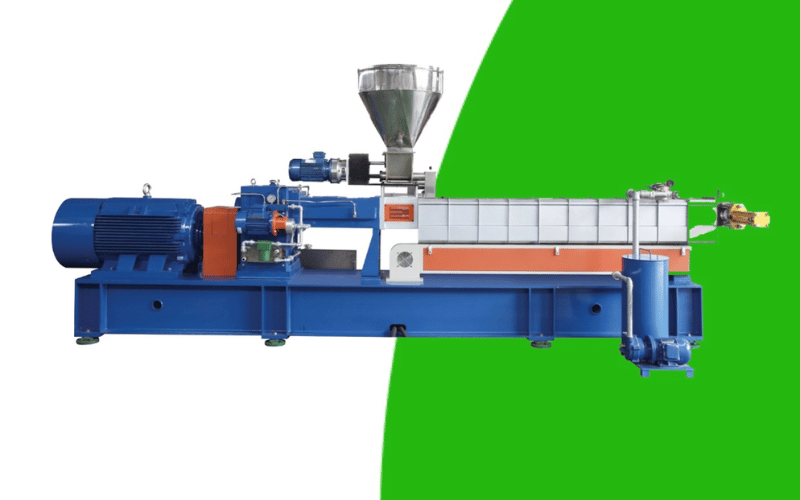
Twin screw extrusion is a cornerstone of modern manufacturing, combining the processes of melting, mixing, and shaping materials in a single, continuous operation. It refers to the use of two intermeshing, co-rotating screws within a heated barrel to process a wide range of materials, most notably polymers.
This technology is critical for compounding, where additives and fillers are precisely blended into a polymer base to create materials with specific properties. In this blog, we will explore the fundamental principles of twin screw extrusion, from its core mechanics to the factors that influence selecting the best twin screw extruder for your specific manufacturing needs.
Twin Screw Extrusion Principles
Twin screw extrusion uses a system composed of two intermeshing screws and a barrel to function as a continuous mixer. With its unique ability to process high-viscosity materials, each section of the extruder’s barrel offers independent control over temperature, material residence time, and shear strength.
Various raw material components, such as polymers, additives, fillers, and stabilizers, are added to the screws at once or in stages through one or more feeding ports. The material is then transported through different zones to complete a series of fundamental processing steps. These include solid conveying, melting under pressure, distributive and dispersive mixing, devolatilization, melt conveying, and finally, extrusion and shaping.
The traditional single-screw extrusion process generally uses a base polymer as the raw material. It melts and mixes the material through external heat and the shear friction generated by the screw’s rotation. The molten material is then pushed through a die, cooled, and shaped to create the final product. This process primarily involves physical changes where the material transitions from a solid state to a liquid (viscous flow) state and back to a solid state. Twin screw extrusion, however, is far more advanced, enabling complex compounding, blending of dissimilar materials, and even reactive processes.
The viscosity of polymer systems can change dramatically during processing, especially when additives or fillers are introduced. When material viscosity is high, a standard single-screw extruder may struggle to provide adequate mixing or conveying pressure. Twin screw extrusion excels in these conditions. The intermeshing, self-wiping action of the screws can handle high-viscosity materials effectively, providing the intense mixing required to create a homogeneous blend and combining multiple processing steps into a single, continuous operation.
The final properties of the extruded compound are determined by the base materials and additives used. However, the process itself significantly influences the outcome by controlling the conditions at the micro-level. For twin screw extruders, rheology (flow behavior), heat transfer, and mixing intensity play a key role in the final product quality, and these factors are all interconnected and influence each other throughout the process.
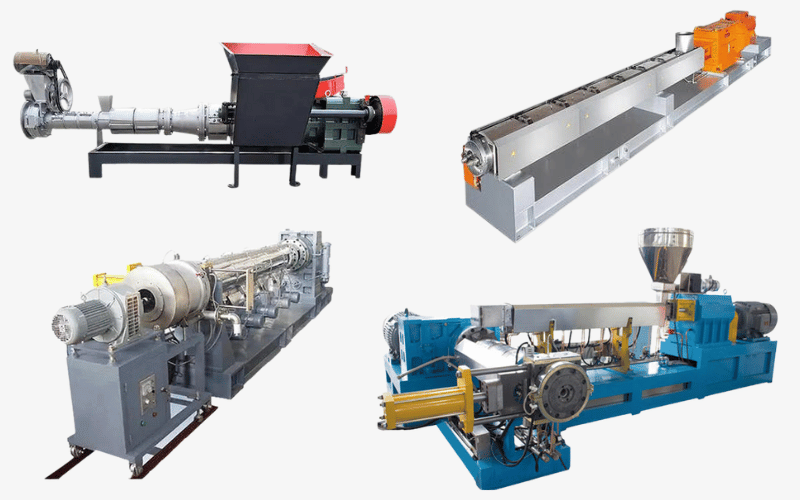
Applications of Twin Screw Extrusion
Twin screw extrusion has been widely used in polymer compounding, blending, devolatilization, and reprocessing, and has played an important role in material modification, masterbatch production, and high-performance plastic manufacturing.
The key applications of twin screw extruders are as follows:
- Compounding and Blending of Polymers: Mixing base polymers with reinforcing agents or fillers to enhance their physical and mechanical properties significantly.
- Production of Masterbatches and Additives: Dispersing high concentrations of pigments, stabilizers, or other additives into polymer resins for consistent color or functionalization.
- Processing of Engineering Plastics: Handling temperature-sensitive and high-viscosity materials required for advanced applications in the automotive and electronics industries.
- Recycling and Reprocessing of Plastics: Converting post-consumer or post-industrial plastic waste back into high-quality, usable pellets, supporting sustainable manufacturing.
- Manufacturing of Specialty Products: Creating complex polymer alloys and composites by thoroughly mixing different polymers to achieve superior performance characteristics.
What Is The Best Twin Screw Extruder?
Equipment requirements for twin screw extruders:
1. Sufficient Melting and Processing Time
The extruder must provide enough time for the materials to melt, mix, and homogenize. Additionally, there must be adequate time in the devolatilization section to remove volatiles from the product, which requires the extruder to have a large length-to-diameter (L/D) ratio.
2. Narrow Residence Time Distribution
The material’s residence time distribution should be narrow to ensure consistent processing. At the same time, it is crucial to prevent some materials from degrading or undergoing other side reactions due to extended residence times at high temperatures.
3. Excellent Venting Performance
During compounding, it is necessary to remove moisture, trapped air, and other volatile components in the material. This typically requires achieving high vacuum levels quickly without causing the extruder to overflow or lose material (vent flow).
4. Strong Conveying and Shearing Capability of the Screw
The screw must have strong conveying and shearing capabilities. Since the viscosity of the polymer blend can vary significantly after melting, making mixing and conveying difficult, the screw’s conveying capacity needs to be enhanced. Intense shearing is also essential for adequate dispersive mixing.
5. Good Heat Transfer Function
During high-shear compounding, the frictional heat released must be quickly removed from the system to prevent material degradation. Therefore, the extruder barrel should have excellent cooling capabilities to maintain precise temperature control.
The machines used for extrusion can be single-screw extruders, twin-screw extruders, and reciprocating pin screw extruders. A comparison of the three is as follows:
|
Twin Screw Extruder |
Single Screw Extruder |
Reciprocating Pin Screw Extruder |
|
|---|---|---|---|
|
Advantages |
High efficiency, precise control, multi-function, easy operation, good plasticity, and excellent mixing, heat transfer, and exhaust performance. |
Simple design, low price, good plasticization, low energy consumption, low noise, stable operation, large bearing capacity, and long life. |
Features uniform shearing, high dispersion, and high filling capacity, combining the advantages of single and twin screw extruders. |
|
Disadvantages |
The structure is complex, the price is high, and the complex flow in the meshing area is difficult to analyze accurately. |
Material transportation relies on friction, limiting feeding performance. Powders, pastes, and fillers are difficult to add. High head pressure reduces productivity. |
Its complexity may affect the ease of operation and increase maintenance costs. |
|
Scope of use |
Suitable for applications that require high mixing and high-quality products. |
Ideal for materials that do not require high mixing uniformity. |
Used for applications with high requirements for mixing uniformity and plasticizing effect. |
The most popular and practical option today is the twin-screw extruder
Extruders required for different compounding tasks are specifically designed. Unlike general-purpose extruders, compounding processes typically use co-rotating twin-screw extruders because they have the following characteristics:
- Highly efficient mixing function to improve uniformity.
- Highly efficient devolatilization function.
- Highly efficient heat removal function to reduce the temperature gradient of the materials.
- Reasonable material residence time.
Compounding can be performed with counter-rotating twin-screw extruders, but it is less common than with co-rotating twin-screw extruders.
Application of counter-rotating twin-screw extruders in compounding
They are often used in applications that require low shear and better control of material residence time, such as processing PVC.
Compared with co-rotating extruders, counter-rotating extruders provide lower shear. This is advantageous for processing shear-sensitive materials such as PVC, which might otherwise degrade. Although counter-rotating extruders provide adequate distributive mixing, they are generally less effective than co-rotating extruders for dispersive mixing. This means they may not be well-suited for applications requiring thorough dispersion of fillers.
The design of counter-rotating extruders enables better control of residence time, which is essential for materials that require a precise temperature history to avoid degradation.
While compounding can utilize counter-rotating twin-screw extruders, it is less common for general-purpose applications due to their lower shear mixing capabilities. Co-rotating twin-screw extruders are often favored for their efficient mixing, better temperature control, and versatility, making them more suitable for a broader range of compounding applications. However, for specific processes that require low shear and precise residence time control, counter-rotating extruders remain a viable option. Ultimately, the best twin screw extruder depends on your particular needs.
Choosing Between Co-Rotating and Counter-Rotating Twin Screw Extruders
Co-rotating twin-screw extruders are often favored for their efficient mixing, better temperature control, and versatility, making them more suitable for a broader range of compounding applications.
In contrast, counter-rotating twin screw extruders are often used in applications that require low shear and better control of material residence time. Compared with co-rotating extruders, counter-rotating extruders provide lower shear, which is advantageous for processing shear-sensitive materials that might otherwise degrade. Although they provide adequate distributive mixing, they are generally less effective than co-rotating extruders for dispersive mixing. This means they may not be well-suited for applications that require the thorough dispersion of fillers.
The design of counter-rotating extruders allows for better control of residence time, which is essential for materials that require a precise temperature history to avoid degradation. While compounding can utilize counter-rotating twin-screw extruders, it is less common for general-purpose applications. However, for specific processes that require low shear and precise residence time control, counter-rotating extruders remain a viable option. Ultimately, the best twin screw extruder depends on your particular needs.


 English
  Portuguese
  Spanish
  Korean
  Russian
  German