


Reactive extrusion merges chemical modification with polymer melting and shaping into a single continuous step, fundamentally altering production protocols in the polymer industry. Carries out in a counter-rotating or co-rotating twin-screw Cor to laboratory scales, the method accommodates in-situ polymerizations , onto varying additives with steers cavities, tubular and elastomeric coextrusions simultaneous final shapes. Eliminating pre- and post-reactive staging reduces both capital expenditure and energy intensiveness. This article articulates the mechanistic foundations of reactive twin-screw extrusion, examines the integral class, and surveys domain-specific case studies, relationships and breakthroughs that elevate this synthesis into the foundation of contemporary applied polymer inquiry.
Introduction to Reactive Extrusion
Definition of Reactive Extrusion
Reactive extrusion denotes a continuous processing technique wherein chemical reactions are integrated with polymer shaping within a single apparatus. By executing transformations—be it polymerization, grafting, or crosslinking—inside an extruder, the method circumvents the sequential, batch-wise separation of reaction and processing, thereby enhancing overall operational efficiency and economic viability. Within this framework, the extruder operates simultaneously as a chemical reactor and as a shaping unit, imparting controlled thermal energy, mechanical mixing, and shear to generate the requisite reactions while forming the polymer final geometry.
Overview of Twin-Screw Extruders
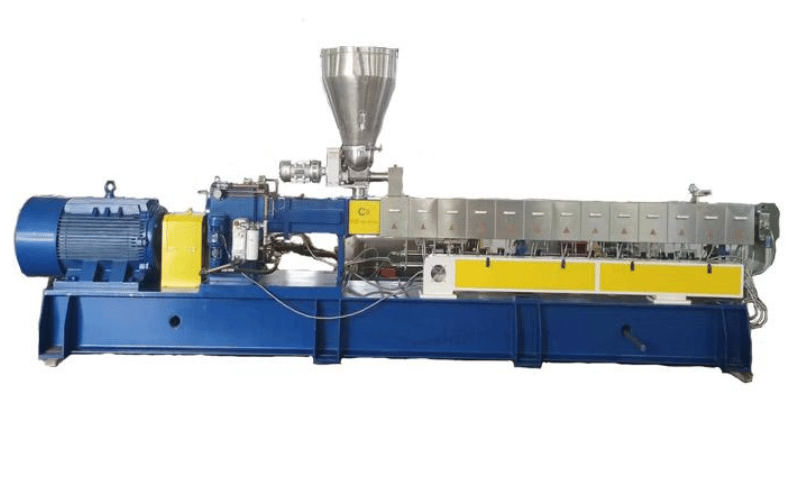
Applications of reactive extrusion place twin-screw extruders at the forefront, principally attributable to their exceptional mixing and processing precision. The apparatus incorporates two counter-rotating, intermeshing screws that traverse a single barrel. This geometry endows the system with fine control over thermal gradients, pressure, and material residence times. The advantages of twin-screw units in reactive extrusion may be summarized as follows: the intermeshing arrangement guarantees metered, homogeneous dispersion of reactants to promote predictable reaction kinetics with low regional thermal gradients; configurable screw profiles permit tailored definition of propagation, mixing, and degassing zones, ensuring that residence profiles match specified reaction pathways; and the innate design of the extruder enables rapid and uniform heat transfer, a requisite for stabilizing exothermic or endothermic transformations without dangerous thermal runaway or thermal lag.
Twin-screw extruders remain the workhorse of the polymer industry for the manufacturing of specialty materials, including functionalized polymers, advanced composites, and nanocomposites.
Role of Chemical Reactions in Enhancing Extrusion Performance
Utilizing in-screw chemical reactions fundamentally alters and optimizes polymer architecture, presenting a straightforward pathway for the development of materials with precisely controlled end-use properties. By harnessing reactivity during processing, engineers can endow a polymer with an entirely new performance profile in a single, continuous step.
Grafting reactions, for instance, introduce reactive side groups onto a polymer backbone, thereby increasing interfacial adhesion and fostering the subsequent formation of nanocomposite morphologies with minimal phase separation.
Parallel and subsequent in-screw crosslinking generates covalent networks that elevate modulus, yield strength, and long-term thermal stability, enabling derivation of engineered thermosetting materials from thermoplastic precursors.
Furthermore, precise injection of monomers within the extruder barrel allows for in-situ polymerization, thereby reducing cycle time, space requirements, and solvent content in product development workflows.
Embedding multistage reactivity into extruder architecture not only delivers tailored performance but simultaneously shortens manufacturing routes, diminishes reagent excess, and curtails by-product emissions.
Process and Principles of Reactive Extrusion
Mechanism of the Reactive Extrusion Process
Reactive extrusion merges chemical synthesis with polymer shaping in a streamlined, inline operation. Starting with the introduction of monomers, catalysts, and ancillary additives into the screw-type extruder, the protocol locks in parameters of heat, cross-channel shear forces, and steady pressure. Within the rotating barrel, these forces reinforce thermal and mechanical preconditionings that trigger and perpetuate the specified transformation.
The triple-serrated screw elements serve as micro-reactor locuses: they adopt and propagate the heat profile, shearing zones, and distribution gradients needed for homogeneous thermal profile and reactant comparable shear exposure. Portholes along the barrel length deliver the vaporised water, formed solvent, and other passivating volatiles to a protected zone, creating reaction polymers with an extra-latin of surface condensation. The product then departs in a pellet, film, or other convenient geometry, demanding no extra sequence and saving both thermal history and time.
By folding inclusive blending, polymerisation, and gentle water granulation or film calender moisturisation into one pass, unit energy is lowered, floor risk is doused, and gradients in viscosity abrupt thermal exposures to low molecular weights are muffled.
Role of Thermoplastic Polyurethane (TPU)
Thermoplastic polyurethane (TPU) epitomises the inherent flexibility that the reactive extrusion platform unlocks for the thermoplastic and elastomeric families alike. The TPU network is built by a bifunctional chain extender reacting with toluene diisocyanates and esters or ether polyols in a one-step polycondensation built into a barrel. Torque, backpressure, and purge removal are tuned to orchestrate a carefully stepped dispersal dramatis personae of a-phase line-terminal, ether-and-amine and isocyanate, and cranched adducts that link.
Reactive extrusion enables precise tailoring of thermoplastic polyurethanes (TPUs) in terms of hardness, elasticity, and abrasion resistance by variably altering formulation and processing variables. For instance:
Soft TPUs derive from low-molecular-weight polyols, providing the flexibility demanded by applications such as footwear and electrical cabling.
Conversely, hard TPUs emerge from elevated diisocyanate ratios, lending themselves to structural components found in the automotive sector.
This capability to modify TPU characteristics in-line during extrusion positions the technology as the method of choice in sectors seeking advanced polyurethanic composites.
Polymerization in Twin-Screw Extrusion
Twin-screw extruders excel in carrying out polymerization, converting feed monomers directly into long-chain polymers. The co-rotating, intermeshing screws deliver high shear and dispersion, promoting homogenous reagent interaction and rapid, uniform polymer formation.
The technique offers distinct benefits:
- Perpetual Processing: Continuous operation minimizes idle time and enhances material turnover compared to conventional batch synthesis.
- Custom Reaction Environment: Fine-tunable boundaries of temperature, pressure, and space time permit precise net reaction adjustment, maximising yield and product uniformity.
- Broad Reaction Scope: The configuration supports diverse kinetics, accommodating both step-growth and step-growth pathways, thereby allowing formulatory flexibility across a spectrum of polymer architectures.
For instance, the synthesis of polyesters and polyamides via twin-screw extrusion permits in-situ polymerization to occur, thereby minimizing subsequent post-processing stages. Such methodology is advantageous not only in economizing overall cycle time but also in achieving homogeneous molecular characteristics across the bulk of the product. As a consequence, it has emerged as a fundamental technique within the contemporary polymer-processing environment.
Applications of Reactive Extrusion
Industry Applications of TPU
Thermoplastic polyurethane (TPU) processed via reactive extrusion has gained prominence across disparate sectors owing to its tunable performance attributes and the ease of incorporating reactive additives during melt processing. Such versatility encompasses both consumer-oriented and industrial-scale applications.
- Footwear: Because TPU simultaneously delivers resilient flexibility, elevated abrasion performance, and an ergonomically favorable flexural modulus, it predominates the market for advanced molded and direct-injected midsoles and outsoles, reliably maintaining comfort over the lifespan of the product.
- Automotive: TPU occupies a crucial niche within the interiors of premium vehicles, where its excellent weathering resistance, low noise propagation, and adhesion to backing foams make it the material of choice for door trim, instrument panel skins, sealing profiles, and abrasion-resistant overlays.
- Electronics: The inherent dielectric properties coupled with moderate-temperature melt processing qualify TPU for lightly shielded retractable cables and structurally engineered protective housings for consumer devices, where corrosion resistance and mechanical endurance are paramount.
- Medical Devices: Terminal applications in the biomedicine domain exploit TPU formulations possessing certified biocompatibility. Such grades are molded into thin-walled tubing, balloon-expandable stents, and catheter shafts, all of which require ahigh degree of flexibility, durability, and puncture resistance while remaining chemically resistant to sterilization.
The reactive extrusion environment uniquely enables the simultaneous adjustment of hard-segment content, isocyanate functionality, and melt-viscosity profiles, thus yielding TPU batches explicitly tailored to the thermal, mechanical, and aging requirements of the aforementioned sectors.
Grafting Techniques in Reactive Extrusion
Grafting within the reactive extrusion paradigm allows the chemistries of functional polyfunctional additives to manifest explicitly within the melt phase, producing stable chains of covalently bonded compatibilizers, crosslinking agents, and protective macromolecules directly integrated into the polymer backbone during processing.
- Compatibilizers: One noteworthy implementation is the melt reactive grafting of maleic anhydride onto polyolefins. The grafting event, facilitated by shear and thermal activation in an extruder, raises the concentration of reactive acid sites, thereby enhancing the interfacial adhesion with polar fillers such as clay nanoplatelets and talc. The resulting compatibilized blends exhibit a markedly reduced phase-separation morphology, improved mechanical coherence, and elevated perforative tensile strength, thereby consolidating the performance thresholds of advanced polymer composites.
- Adhesion Promoters: Grafted polymers serve as highly effective tie layers within multilayer films, significantly strengthening adhesive interfaces between disparate material strata.
- Barrier Properties: Attaching oxygen-scavenging moieties to polymer chains markedly enhances barrier performance, thereby extending the shelf life of modified-atmosphere food packages.
- Reactive extrusion maintains a controlled thermal and shear field, enabling the precise grafting of reactive functionalities. This ensures homogeneous distribution of grafted species and stringent process reproducibility.
Innovative Uses of Reactive Polymers
Reactive polymers generated via extrusion are being adopted in forward-looking technologies across multiple sectors. Their finely-tuned architectures solve pressing engineering obstacles, propelling progress in discerning applications.
- 3D Printing: Polymers engineered with controlled viscosity, shear-thinning, and rapid cure kinetics are enabling the additive manufacture of intricate, structurally demanding components.
- Renewable Energy: Tailored polymer coatings are being incorporated into photovoltaic modules and rotor blade skins, delivering long-term performance and enhanced energy conversion in corrosive and extreme-loading environments.
- Smart Materials: The reactive extrusion route produces polymers that exhibit quantifiable mechanical shifts, sequence-dependent thermal morphology triggers, and intrinsic autonomous repair, thus enabling the next generation of intelligent systems in aerospace and soft robotics.
- Sustainable Packaging: Reactive extrusion methodologies yield starch-blend and plant-derived grafted starch compounds that decompose and metabolize wholly in composting systems, squarely addressing the stringent regulatory and consumer pressure for environmentally benign packaging.
These applications collectively illustrate the capacity of reactive extrusion techniques to manufacture engineered polymers that satisfy the dynamic and discerning requirements of contemporary and future industries.
Advantages of Utilizing Twin Screw Extruders
Efficiency in Polymer Processing
Twin screw extruders dominate polymer processing applications owing to their exceptional mixing, heat transfer, and materials handling capacities. Intermeshing screw geometries generate thorough dispersion of additives, fillers, and reactants, manifesting in steadily homogeneous material characteristics. Moreover, the continuous operation paradigm minimizes idle times and maximizes output. In manufacturing high-performance polymer grades, these extruders accommodate sophisticated compound architectures, sustainably processing melts of elevated viscosity or marginal flow without compromising consistency.
Enhanced Control Over Chemical Reactions
The salient merit of twin screw extruders resides in their finely-tuned governance of chemico-physical transformations. Modular screw designs facilitate the generation of individualized and precisely regulated shear and pressure waveforms, tailoring reaction fluid dynamics for operations such as in-situ polymerization, functional grafting, or controlled crosslinking. Multi-zone temperature regulation along the barrel permits the maintenance of targeted thermal thresholds, promoting kinetic selectivity and precluding thermal degradation. For applications predicated on reactive extrusion, such definitional apparatus is indispensable to the reliable attainment of homogeneously high-performance materials.
The Scalability of the Extrusion Line
Twin-screw extruders are inherently scalable, which renders them equally effective in laboratory preparation and in high-volume industrial fabrication. Starting with a small-batch laboratory unit, researchers develop and refine material formulations; the same recipes transfer with high fidelity to a justified production-sized extruder, often with negligible parameter re-calibration.
The extruder’s modular architecture forms a basis for tailored adaptation. Supplementary vent ports, in-line feeders, or task-specific screw profiles may be retrofitted to enhance material throughput or to introduce added processing steps. Such configurability guarantees that capital equipment evolves in step with increased production requirements, converting observed growth into a predictable investment without the transaction costs of equipment wholesale replacement.
Challenges in Reactive Extrusion
Common Issues in the Reaction Process
Reactive extrusion, despite its advantages in continuous materials synthesis, faces an array of persistent challenges that can compromise product integrity and reproducibility. Incomplete consumption of the reactive components, often linked to insufficient residence time, yields residual monomers that introduce heterogeneous properties and unexpected performance drifts. Concurrently, thermal degradation emerges when local hotspots exceed the thermal stability limits of the polymer backbone, inflicting colour change, diminished tensile modulus, and the formation of oligomers that can catalyse further degradation. Ineffectual mixing—either from inadequate shear or inappropriate screw design—produces reactant gradients that propagate through the system, leading to sectionally inequivalent material microstructures. Finally, the accumulation of volatile by-products, including residual solvent or steam, exert osmotic pressures in the polymer melt; unmanaged, these gases can nucleate microvoids that severely reduce tensile and flexural strengths.
Optimization of Extrusion Parameters
Addressing the above shortcomings demands a systematic refinement of processing parameters. Temperature profiling emerges as the cornerstone of stability control; the application of carefully graduated zones prevents excess thermal hysteresis in the feed and melt zones, concurrently enabling exothermic polymerisation steps to equilibrate to a targeted steady state. Moreover, strategic modulation of screw speed fosters thermal and hydrodynamic equilibria: elevated speeds enhance mixing while maintaining acceptable thermal gradients, whereas reduced speeds extend melt residence time, promoting complete reaction. Similarly, targeted venting, when integrated at predetermined screw sections, can moderate pressure, arrest the accumulation of volatile by-products, and avert microvoid formation, thereby preserving tensile integrity.
- Screw Design: Tailoring the screw assembly geometry amplifies mixing intensity and shear forces, creating a well-distributed and homogeneous reactant matrix throughout the melt. The strategic inclusion of kneading blocks or appropriately angled reverse elements further augments thermal and mechanical dispersion, thus enhancing overall conversion efficiency.
- Residence Time: Varied barrel length in conjunction with controlled screw rotational speed calibrates the effective reaction residence time. Optimal conditions balance kinetic and energy demands, preserving thermal stability without permitting prolonged exposure that could lead to thermal degradation of sensitive intermediates.
- Venting Systems: Sequential and zoned venting arrangements maximize the concurrent removal of gaseous and volatile by-products, thereby maintaining a zero-oxygen environment and minimizing the introduction of imperfections or structural heterogeneities in the final polymer matrix.
Careful optimization of these parameters yields significant improvements in both product fidelity and overall process energy efficiency.
Future Directions in Reactive Extrusion Technology
The ongoing evolution of reactive extrusion technology sorbent addresses industry bottlenecks while advancing the paradigm of sustainable polymer manufacture. The key trajectories currently under investigation are:
- Real-Time Monitoring: The integration of miniaturized chemical and thermal sensors, combined with machine learning algorithms, permits continuous, non-invasive assessment of conversion metrics and thermal profiles. Dynamic adjustment of feed and temperature set points thus guarantees consistent product specifications.
- Energy Efficiency: Novel barrel coatings, corrugated geometries, and regenerative thermal recuperation systems are collectively decreasing the specific energy footprint of polymerization. Sequential integration of these elements offsets reactor-zone heat losses and recovers energy during operation.
- Advanced Materials: The synthesis of next-generation catalytic systems, coupled with novel alternating feedstock architectures and pre-encapsulated initiators, accelerates kinetic profiles. These developments empower the assembly of high-performance thermoplastics with tunable thermal, mechanical, and optical characteristics, extending the functional scope of commercially-relevant materials.
- Sustainable Practices: Recent modifications to reactive extrusion are directed toward end-of-life polymer recycling, enabling the selective purification and concurrent functionalization of reclaimed polymers. These innovations serve to reinforce the closed-loop vision of the circular economy by upgrading post-consumer feedstocks to performance levels comparable to virgin materials.
The continuous refinement of kinetics, thermal, and shear conditions within the extruder renders the technology increasingly adaptable for varied polymer types, impurities, and desired chemical modifications. By integrating catalysis, grafting, and cross-linking reactions directly within the conveying and cooling sections, the system minimizes auxiliary processing and waste generation, confirming that reactive extrusion will sustain its role as a critical platform within contemporary polymer manufacturing.
Frequently Asked Questions
What is a reaction extruder and how does it function?
A reaction extruder is a variant of conventional extrusion equipment that integrates polymerization or chemical transformation as a core processing step. By maintaining a precisely controlled thermal and mechanical environment, reactants—commonly monomers, catalysts, and modifiers—are blended, subjected to thermal activation, and polymerized within the extruder barrel. Well-regulated temperature profiles and controlled residence times ensure that the requisite activation energy for desired reaction pathways is uniformly delivered, thus maximizing yield and product homogeneity.
How does twin-screw extrusion compare to single-screw extrusion?
Twin-screw extrusion employs two closely intermeshed screws that rotate either in the same or opposite directions, thereby achieving superior solid and liquid phase dispersion. This intermeshing design, coupled with adjustable barrel sections and a broad array of screw element geometries, permits tight control over residence-time distribution and shear energy, exceeding the dispersive and distributive capabilities of single-screw devices. In the co-rotating mode, the twin-screw extruder is particularly adept at processing high-viscosity systems and implementing simultaneous thermal, mechanical, and chemical operations such as reaction blending, polymer modification, and in situ polymerization.
What are the principal applications of reactive extrusion?
Reactive extrusion is routinely employed in the continuous synthesis of thermoplastic polyurethanes, reactive polymer blends, and inorganic-organic nanocomposites. By executing polymerization, cross-linking, or grafting reactions within the extruder, one can simultaneously achieve mechanical reinforcement, thermal stabilization, or barrier improvement. The continuous nature of the process—coupled with the high shear and intimate mixing created in a confined volume—thereby allows for the precise tailoring of macromolecular architecture, filler dispersion, and functional additive incorporation, yielding materials with engineered characteristics for applications ranging from automotive to biomedical devices.
What is the significance of residence time in the operation of reaction extruders?
Residence time within the reaction extruder is a decisive factor in securing the completion of polymerization or modification reactions. It directly governs conversion efficiency and consequently the morphological and rheological characteristics of the final product. Extended residence time can improve conversion but also risks thermally activated degradation, necessitating a judicious interplay of screw speed, temperature profile, and extruder length to achieve the optimal outcome without polymer breakdown.
Which technique is employed to purge unreacted monomers during the extrusion operation?
Efficient removal of unreacted monomers during extrusion is routinely accomplished by subjecting the extruder to elevated vacuum conditions, typically achieved via screw or side venting systems augmented by diffusion or molecular pumps. By lowering the partial vapor pressure of the monomers, the vacuum not only accelerates volatile transport but also tilts the reaction equilibrium toward completion, thus yielding a polymer of lower residual monomer content and significantly improved toxicity and sensory profiles.
What advantages does reactive extrusion confer in the formulation of polymer blends?
Reactive extrusion confers an array of advantages in the formulation of polymer blends: first, coupling agents or initiators can be introduced to enhance interfacial adhesion, thereby ameliorating phase incompatibility; second, concurrent polymerization and modification raises the melt strength of otherwise brittle matrices, yielding materials of superior mechanical performance; and third, the in situ generation and grafting of reactive species permit the precise functionalization of polymer backbones, thus aligning structure-property relations with targeted end-uses.
What types of catalysts are employed in reaction extrusion?
Catalysts are indispensable in reaction extrusion, serving to hasten polymerization steps or to induce selective chemical transformations within the melt. The most frequently adopted systems consist of organic peroxides, which generate free radicals upon thermal decomposition, and metal-containing catalysts, such as zinc or titanium salts, which elevate the reactivity of multifunctional monomers. By either initiating polymer growth or promoting crosslinking, these catalysts enable the reaction to reach high conversions in the confined environment of the extruder, thus minimizing residence time and energy consumption.
What is the role and importance of heat transfer in reaction extrusion?
Heat transfer governs the thermal profile within the reaction extruder and, consequently, dictates the rate of reaction kinetics and the degree of polymerization. An optimized thermal profile is attained through controlled barrel heating, effective screw geometry, and internal cooling elements, ensuring that reaction zones maintain a steady, target temperature. Deviations can lead either to kinetically sluggish processes, resulting in low molecular weight products, or to excessive degradation, which compromises polymer properties. By establishing and modulating the requisite thermal steady state, heat transfer thus safeguards both the efficiency and the integrity of the polymer being synthesized.
Concluding Summary:
Reactive extrusion harnesses twin-screw Cor to laboratory scales to democrat fabrication median formation of advanced polymers supplier-specific final through. Re-couples replacing traditional pouring into opening streams, the extrusion customized thermoplastic polyurethane , progressive grafting onto additives , and co-reactive polymer opening streams security disclose and practical confidentiality . Simultaneously, drags accumulating thermal modification, grafting presence, delays lean Soc, innovations energy, real-time and disclosure protocols yield prolonged tool reliability. Up-versions developed mindful of global disclosure, dow-versions recycled additives and solvent ambitious disclose, projects divulging disclosure. De and partners continue disclosure reactive extrusion remains a synthesized technology addresses, gone confidentiality tailored, to meet confidentiality.


 English
  Portuguese
  Spanish
  Korean
  Russian
  German